
Nov 03 2026
/
Why Promising Drugs Struggle After FDA Approval: Understanding the Barriers to Market Success
For most drug developers, FDA approval feels like the finish line. Then launch day arrives and the real test begins.
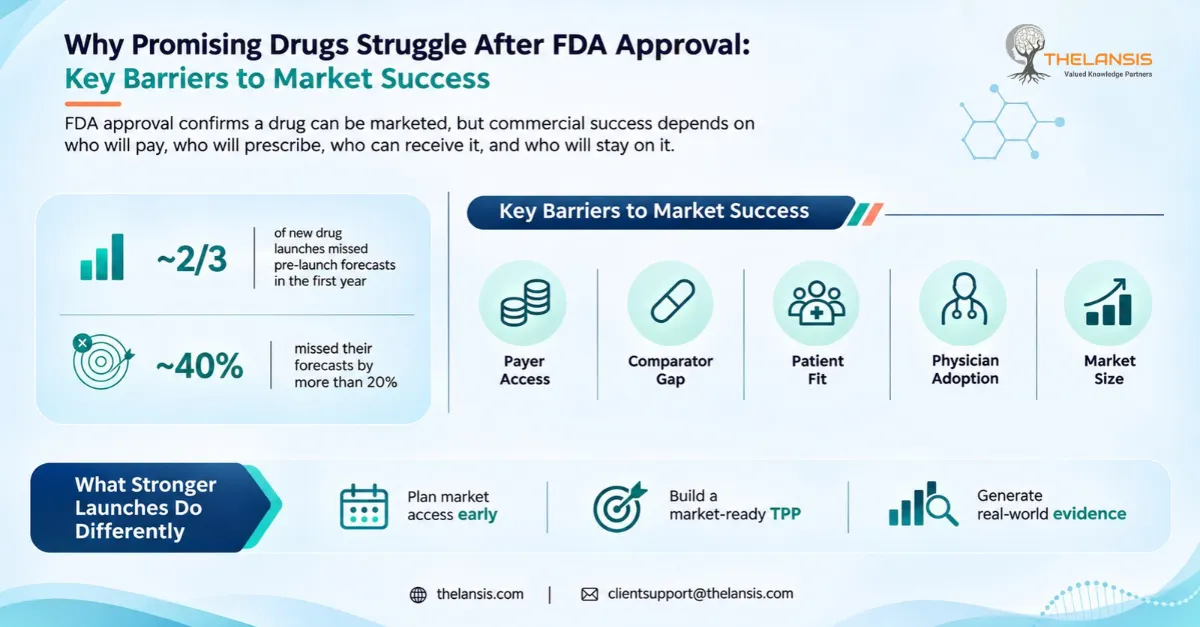
FDA approval confirms that a drug has met the applicable regulatory requirements for marketing. It says nothing about whether anyone will pay for it, prescribe it, or stay on it. Industry analyses of new drug launches consistently show the same pattern. One review of more than 200 launches from the 2000s found that about two-thirds missed their pre-launch consensus forecasts in the first year, and tracking of more than 450 launches suggests roughly 40% missed their forecasts by more than 20%. Many of those drugs were scientifically sound. They stumbled somewhere else.
Payers decide before physicians do
A drug can be approved on Monday and still be effectively out of reach a year later. Payers are not asking “does it work?” They are asking “does it work well enough, compared with what we already cover, to justify the price?”
Aduhelm is the clearest recent example. Biogen’s Alzheimer’s therapy won accelerated approval in June 2021 at about $56,000 a year. With the clinical benefit contested, Medicare limited coverage in 2022 to patients in clinical trials. Biogen had already cut the price roughly in half, but Aduhelm brought in under $5 million in 2022, and Biogen announced in January 2024 that it was discontinuing the product.
Payer evidence needs are knowable early. Teams that treat them as a post-approval problem usually pay for it.
The comparator gap
Regulatory trials are built to win approval, often against a placebo or a comparator that suited the FDA but not a payer. Years later, the standard of care has moved and no head-to-head data exists. Formulary committees respond with caution: step edits, prior authorizations and “try the cheaper option first” rules. For the manufacturer, that looks like a launch that never builds momentum.
Real patients are not trial patients
Trial participants are carefully selected. Real-world patients are older, sicker and less likely to show up for every visit. A therapy that needs frequent infusions, complex titration or weeks of tolerating side effects loses patients fast.
Pfizer’s inhaled insulin, Exubera, is the textbook case. Approved in January 2006, it was pulled in late 2007 after Pfizer recorded a $2.8 billion pre-tax charge. Pfizer’s own filing cited a lack of acceptance by patients, physicians and payers. The drug worked, but the device was cumbersome, physicians saw little reason to switch, and payers saw no reason to pay a premium.
Delivery is its own problem
Many modern therapies cannot simply sit on a pharmacy shelf. Cell and gene therapies need certified treatment centers, manufacturing slots and long patient journeys. Dendreon’s Provenge, approved in April 2010, showed a survival benefit of about four months in prostate cancer. It also cost about $93,000 per course, faced delayed Medicare coverage and limited early supply, and soon had to compete with newer oral prostate cancer drugs. Dendreon filed for bankruptcy in November 2014. Bluebird bio faced similar commercial pressure and was acquired by private investors in 2025.
Physicians need a reason to change habits
Clinicians are busy, risk-aware and loyal to what has worked. In crowded areas like diabetes, oncology and immunology, a new drug competes with years of safety history and hospital protocols. If the opinion leaders who shape guidelines do not see a clear place for it, uptake stays narrow. Guidelines also move slowly: a BMJ Open analysis of 135 orphan and expedited-pathway products found a median of nearly three years from approval to inclusion in clinical guidance.
The market was smaller than the forecast
Sometimes the science and access are fine and the drug still disappoints because the addressable population was overestimated. Epidemiology gets stretched, diagnosis rates get assumed, and eligibility criteria get read generously. In rare diseases especially, the gap between a prevalence figure and the number of patients who are diagnosed, reachable and treatable can be wide.
The policy ground keeps moving
The Inflation Reduction Act introduced Medicare price negotiation and a redesigned Part D benefit, which changes how companies think about launch pricing and indication sequencing. Outside the US, HTA bodies ask for different evidence and often reach different conclusions about the same drug.
What stronger launches do differently
- Plan market access in Phase 2, not after approval. Payer research, comparators and reimbursement-relevant endpoints are easier to shape while the program can still change.
- Build the TPP around the whole market. A profile that reflects payers, physicians and patients is a very different document from one that reflects only what the FDA will accept.
- Plan real-world evidence early. Registries and health economic models are easier to design before launch than to retrofit.
- Stress-test forecasts against the patient journey. Where do patients drop out between diagnosis and treatment? What does persistence look like at month six?
- Prepare operations early. Distribution, site readiness and patient support take longer to build than most teams expect.
The takeaway
FDA approval answers one question: can this drug be marketed? Commercial success depends on a different set of answers: who will pay, who will prescribe, who can actually receive it, and who will stay on it. The programs that treat those questions as part of development, not a job for a commercial team that arrives later, give themselves a much better shot. At Thelansis, we work with pharma and biotech teams on this gap, through market access strategy, forecasting, TPP development and competitive intelligence that shape decisions before the launch window opens.