

Dec 04 2025
/
Building a Global Price Strategy: How Thelansis Helped a Biopharma Set the Right Launch Price Across 15 Markets
Background:
A biopharma company was preparing to launch a first-in-class therapy in immunology TA. The asset showed strong clinical promise, but its commercial team faced a familiar challenge: every market had different payer expectations, and a single misstep on price in one country could trigger ripple effects across the global reference pricing network.
With 15 priority markets tied together through external reference pricing (ERP) rules, the team needed a clear price corridor that protected the global floor price, maintained headroom for future indications, and aligned with local payer willingness to pay.
That’s where Thelansis stepped in.
Problem Statement:
The global pricing team lacked:
- A harmonized view of payer elasticity across the 15 markets
- A cross-market price corridor that minimized reference price erosion
- A forward-looking assessment of ERP spillover, especially from lower-priced markets
- Early guidance on how different price stacks could influence HTA outcomes and budget impact reviews
They needed a model that combined epidemiology, clinical value drivers, and payer logic without losing real-world practicality.
Objective:
To build an integrated pricing strategy that would help the company:
- Identify the “safe zone” price corridor for each market
- Understand the knock-on impact of list price decisions on ERP-linked countries
- Simulate payer reactions at different price points
- Recommend a launch sequence that protects price integrity globally
Approach:
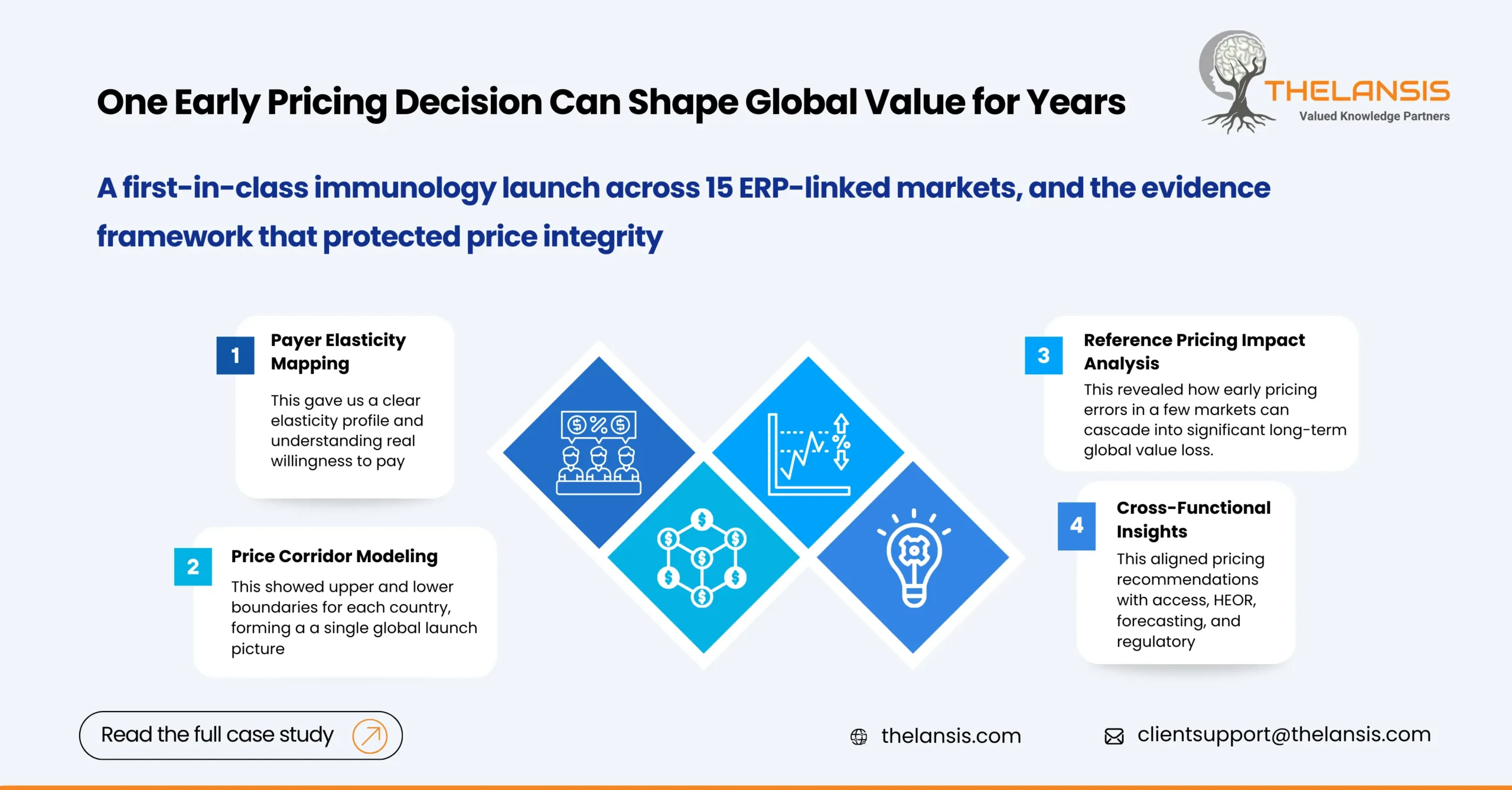
1. Payer Elasticity Mapping
Thelansis ran a structured review of payer behaviour across the 15 markets, using:
- Past HTA decisions for therapies in similar severity and budget classes
- Reimbursement thresholds tied to therapeutic value, QALY signals, and unmet need
- Local budget environments and past discount patterns
This gave us a clear elasticity profile, aided in identifying which markets were value-driven, which were cost-guarded, and where payers had historically accepted premium pricing.
2. Price Corridor Modelling
Instead of using a theoretical model, Thelansis built a pragmatic corridor aligned with:
- Local willingness to pay ceilings
- Competitive benchmarks
- Expected confidential discount expectations
- Risk of triggering renegotiations or re-assessments
The corridor showed upper and lower boundaries for each country, forming a consolidated global picture of acceptable launch prices.
3. Reference Pricing Impact Analysis
ERP relationships were mapped using actual referencing rules (direct, indirect, basket-based, average-based).
We created:
- Multiple launch sequence simulations
- Downward-pressure scenarios if a low price leaked early
- Sensitivity runs for exchange rate swings, clawbacks, and mandatory rebates
These scenarios revealed how a suboptimal price in just 2 of the 15 markets could reduce global revenue potential by nearly 18% within three years.
4. Cross-Functional Insights
The analysis was shared with the client’s market access, HEOR, forecasting, and regulatory teams.
Together, we aligned pricing recommendations with:
- Early economic value messages
- Budget impact narratives
- Phase III evidence readouts
- Anticipated payer objections
This ensured pricing decisions were grounded in clinical value, not only financial equations.
Outcome:
With Thelansis’ pricing assessment, the biopharma was able to:
- Identify an optimal global list price that balances payer tolerance with future indication expansion
- Sequence launches in a way that protects ERPsensitive markets and avoids reference-driven price drops
- Strengthen HTA submissions with realistic price-value justification
- Secure initial reimbursement approvals in the first wave of markets without forced price cuts
Most importantly, the team gained a clear, evidence-backed roadmap that prevented unintended price erosion, preserving long-term value across all 15 markets.