
Oct 03 2026
/
What’s Driving R&D in Triple-Negative Breast Cancer
For years, chemotherapy was the backbone of triple-negative breast cancer (TNBC) treatment because the disease lacked the molecular targets that transformed treatment in other breast cancer subtypes. That treatment paradigm is no longer the whole story.
TNBC has become one of the most active areas of oncology R&D, with checkpoint inhibitors, PARP inhibitors, and antibody-drug conjugates (ADCs) moving into different lines of treatment and patient segments. The result is not simply a larger treatment arsenal. It is a shift in how companies approach clinical development, from treating TNBC as one difficult-to-target disease toward identifying biologically defined populations that can support differentiated therapies.
For drug developers, this creates a more complicated question than simply asking what the next TNBC drug will be. The bigger question is where meaningful differentiation is still possible.
The Disease that made “Biomarker-Negative” a Development Problem
TNBC accounts for roughly 15-20% of breast cancers and is defined by the absence of estrogen receptor, progesterone receptor, and HER2 overexpression or amplification. Compared with hormone receptor-positive disease, TNBC has historically been associated with fewer targeted treatment options, a higher risk of early recurrence and a greater reliance on chemotherapy. That biology created a difficult R&D environment: developers were attempting to find actionable vulnerabilities in a disease that is molecularly heterogeneous and does not have a single dominant therapeutic target.
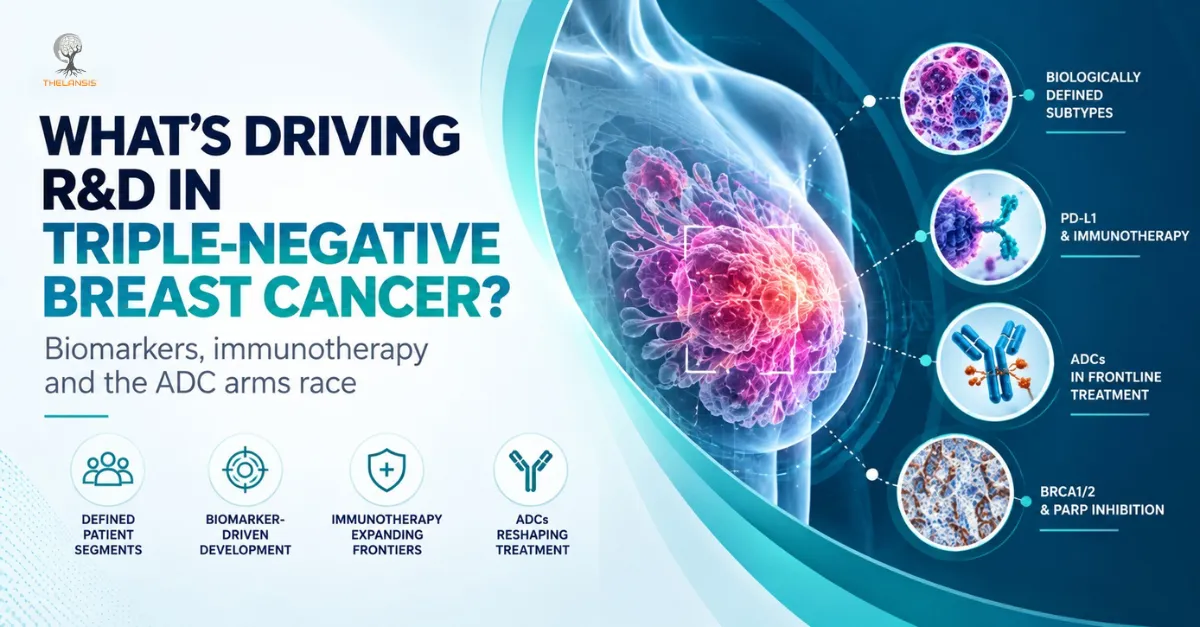
The industry response has increasingly been to segment the population rather than search for one universal TNBC therapy. Germline BRCA status, PD-L1 expression, TROP2 expression, and HER2 expression are now influencing treatment development, while additional targets and molecular subgroups continue to be investigated. This is changing the commercial logic of TNBC R&D. A therapy no longer needs to work across the entire TNBC population to have a meaningful opportunity; it needs to identify a sufficiently large patient population and demonstrate a clinically relevant advantage within that population.
The Genomic Subset Nobody Wants to Miss: BRCA1/2 and PARP Inhibition
The development of PARP inhibitors provided one of the clearest demonstrations of what biomarker-driven R&D can achieve in TNBC. Germline BRCA1 and BRCA2 mutations create a vulnerability in tumors with impaired homologous recombination DNA repair. The phase III OlympiA trial established the clinical value of adjuvant olaparib in patients with germline BRCA mutations and high-risk HER2-negative early breast cancer following chemotherapy. With longer follow-up, the benefit has remained durable: at approximately 6.1 years of follow-up, olaparib continued to show improvements in invasive disease-free survival, distant disease-free survival and overall survival, with a reported overall-survival hazard ratio of 0.72 versus placebo.
The significance for R&D goes beyond olaparib itself. It strengthened the case for identifying patients according to inherited tumor biology and demonstrated how a diagnostic-defined population can become the foundation for targeted development. The implication is important, as biomarker testing is increasingly part of the treatment-development strategy, not simply a diagnostic exercise performed after a drug has been developed.
Immunotherapy Changed the Early-Stage Equation
Immunotherapy created another major shift, particularly in high-risk early-stage TNBC. The phase III KEYNOTE-522 trial established pembrolizumab plus chemotherapy followed by adjuvant pembrolizumab as an important treatment approach for high-risk early-stage TNBC. The latest long-term analysis, presented at ASCO 2026, reported a 7-year event-free survival rate of 78.3% with pembrolizumab versus 69.8% with chemotherapy alone, corresponding to an EFS hazard ratio of 0.68. The overall-survival difference was also maintained: 7-year OS was 85.1% versus 77.2%, with an OS hazard ratio of 0.64.
The R&D implication is significant. Immunotherapy is no longer being evaluated only as an option for patients with advanced disease. Long-term outcomes from KEYNOTE-522 reinforce the value of intervening earlier, when the disease burden and residual risk may be more amenable to durable disease control. That creates a new competitive environment in early-stage TNBC. Developers are increasingly asking whether a therapy can improve pathological response, event-free survival, and ultimately cure rates rather than simply extend survival after metastatic disease develops.
ASCENT-04: The ADC Becomes Part of the First-Line Backbone
The next major development is the combination of ADCs with immunotherapy. In ASCENT-04, sacituzumab govitecan plus pembrolizumab was evaluated against chemotherapy plus pembrolizumab in previously untreated PD-L1-positive metastatic TNBC. Median progression-free survival was 11.2 months with sacituzumab govitecan plus pembrolizumab versus 7.8 months with chemotherapy plus pembrolizumab, producing a hazard ratio of 0.65.
Follow-up data presented at ASCO 2026 also showed an improvement in PFS2, with a hazard ratio of 0.67. PFS2 is particularly relevant because it captures disease control through the next line of treatment and can provide additional information while overall-survival data remain immature.
The development question here is broader than whether one ADC is better than chemotherapy. It is whether an ADC can become the therapeutic backbone around which other active mechanisms are combined. That distinction matters. If ADCs increasingly occupy the centre of first-line treatment, future R&D may focus less on replacing the entire regimen and more on determining which immunotherapy, targeted therapy or next-generation ADC can add meaningful benefit to an established backbone.
The Real 2026 Story: An ADC Arms Race
This is where TNBC R&D becomes particularly competitive. TROP2 has emerged as one of the most intensively pursued targets in the disease, following clinical and commercial validation of sacituzumab govitecan. The success of the first-generation TROP2 ADC has effectively reduced one of the major risks associated with target validation: uncertainty over whether the biology can translate into meaningful clinical benefit. The development strategy has therefore shifted from “Can TROP2 work?” to “How much better can the next TROP2-directed therapy be?”
Datopotamab deruxtecan is an important example. In the phase III TROPION-Breast02 study, previously untreated patients with locally recurrent inoperable or metastatic TNBC for whom immunotherapy was not an option achieved median PFS of 10.8 months versus 5.6 months with chemotherapy. Median OS was 23.7 versus 18.7 months, with a hazard ratio of 0.79.
The significance is not simply that another ADC produced positive data. It demonstrates that the TROP2 class can potentially displace chemotherapy in populations where chemotherapy had remained a principal first-line systemic option. That creates a classic second-mover problem for developers: once a target is clinically validated, differentiation has to come from somewhere else. It may be efficacy. It may be safety. It may be dosing convenience, payload characteristics, linker technology, treatment duration, combination potential, or activity in specific biomarker-defined populations.
Merck is also advancing sacituzumab tirumotecan (MK-2870), another TROP2-directed ADC, across multiple phase III breast cancer programs. Meanwhile, other companies are pursuing different ADC targets and architectures, including HER3- and B7-H4-directed approaches. The result is an ADC landscape that is expanding horizontally rather than simply adding one more product to the treatment algorithm.
Why this Matters More than Another New Drug
The increasing number of TNBC programs reflects a broader change in how R&D capital is allocated. Once a mechanism has demonstrated proof of concept in a clinically meaningful setting, the development risk associated with that target falls. Competitors can then enter with the objective of improving the therapeutic profile or expanding the addressable population.
That pattern is visible across TNBC:
- BRCA biology: clinical validation of PARP inhibition strengthened the role of germline BRCA testing.
- PD-L1: checkpoint inhibition created a biomarker-defined population in which immunotherapy could demonstrate meaningful benefit.
- TROP2: clinical validation of ADC technology has triggered multiple competing programs around the same target.
- New ADC targets: HER3, B7-H4, and other antigens are being explored as companies look for differentiation beyond an increasingly crowded TROP2 field.
For developers, this means the strategic question is no longer simply whether a drug works. It is whether the drug can establish a sufficiently differentiated position before the relevant treatment class becomes crowded.
Earlier-Stage TNBC is Becoming a More Important R&D Battleground
One of the clearest implications of the current development landscape is the growing importance of earlier-stage disease. The metastatic TNBC population remains clinically important, but the strongest recent developments increasingly involve moving effective therapies earlier in the treatment pathway.
KEYNOTE-522 is the clearest example. Rather than waiting for metastatic recurrence, treatment is being intensified around surgery with the objective of reducing residual disease and preventing recurrence.
The same logic is influencing ADC development. If ADCs can demonstrate durable benefit in earlier-stage disease, the commercial and clinical opportunity could extend substantially beyond the metastatic setting. However, the evidence requirements also become higher. In early-stage disease, a drug may need to demonstrate durable event-free or overall-survival benefit, acceptable long-term toxicity, and a clear benefit relative to increasingly effective standards of care. This changes the competitive landscape: developers are no longer competing only against chemotherapy, but against established immunotherapy-containing regimens and other targeted approaches.
Five themes shaping the next wave of TNBC R&D:
- ADCs are becoming a central innovation platform. The rapid expansion of TROP2-directed therapies is validating ADCs as a major development platform in TNBC. The next stage of competition will increasingly depend on differentiation within and beyond validated ADC targets.
- Combination development is accelerating. The success of immunotherapy and ADCs is encouraging combination strategies designed to attack the disease through complementary mechanisms. The key challenge will be demonstrating incremental benefit without creating unacceptable toxicity or treatment complexity.
- Biomarker segmentation is becoming essential. TNBC is not a single biological disease. BRCA status, PD-L1 expression, and other emerging biomarkers are already influencing treatment selection and trial design. Future R&D will increasingly depend on identifying biomarkers that predict which patients are most likely to benefit from specific mechanisms.
- Earlier-stage disease is becoming a major development focus. Long-term KEYNOTE-522 results reinforce the value of improving outcomes before metastatic recurrence occurs. This makes neoadjuvant and adjuvant development increasingly important, but also raises the evidence bar for new entrants.
- Resistance remains the major unresolved problem. Even when TNBC responds to immunotherapy or ADCs, resistance eventually limits treatment benefits for many patients. Understanding why tumors escape TROP2-directed therapy, checkpoint inhibition, or DNA-damage-targeted treatment could be one of the most important sources of future therapeutic differentiation.
What’s Still Unsolved
Despite the pace of development, TNBC remains a difficult disease to treat because its biological heterogeneity has not disappeared. The label “triple-negative” describes what the tumor does not express, but it does not fully explain what drives the tumor. Two patients can both be classified as TNBC while having substantially different genomic profiles, immune environments, and therapeutic vulnerabilities.
This creates a major gap between classification and prediction. PD-L1 testing can help identify patients for immunotherapy, while germline BRCA testing identifies an important population for PARP inhibition. But the industry still lacks reliable biomarkers capable of consistently predicting which patient will benefit most from a TROP2 ADC, a HER3-directed therapy, a next-generation ADC, or a particular combination strategy. That may ultimately be one of the biggest R&D opportunities in TNBC.
The next breakthrough may not come from simply adding another ADC to an increasingly crowded pipeline. It may come from improving the ability to determine which patient should receive which therapy, in which sequence, and at what point in the disease journey. TNBC R&D is therefore moving from a search for a single breakthrough mechanism toward a more complex model built around target validation, biomarker segmentation, combination strategies, earlier intervention, and treatment sequencing.
The companies that can connect those pieces with robust clinical evidence will have the opportunity to differentiate in a field that is becoming increasingly crowded and increasingly sophisticated.
Explore our latest report on Triple-Negative Breast Cancer (TNBC) Market Outlook and Forecast. Click here