
Oct 21 2026
/
The Evolution of PD-1/PD-L1: From Immune Checkpoint Breakthrough to What Comes After Keytruda
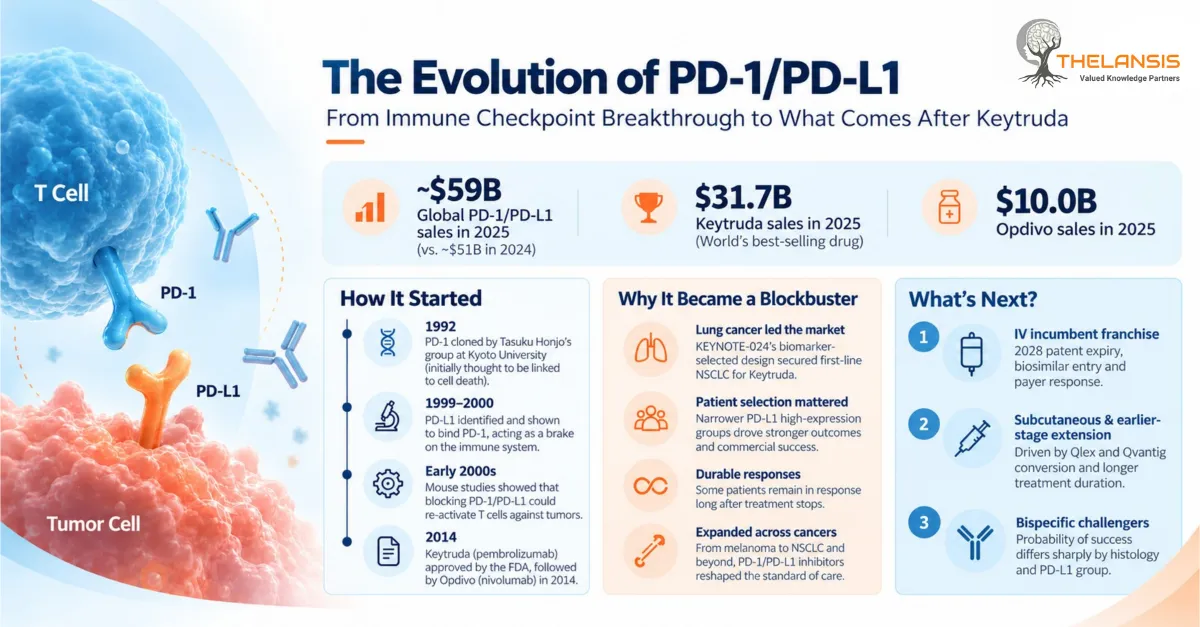
The protein was named for the wrong job. In 1992, Tasuku Honjo’s group at Kyoto University was hunting for genes tied to cell death in T cells and cloned a new one. They called it programmed death-1, or PD-1. The name stuck, even though the protein has little to do with death. PD-1 is a brake on the immune system.
Three decades later, drugs that release that brake sold about $59 billion worldwide in 2025, up from roughly $51 billion the year before. Keytruda alone accounted for $31.7 billion, making it the best-selling drug in the world. Add Opdivo’s $10.0 billion and the two agents together come to nearly $42 billion.
The science has been told well many times. What interests us at Thelansis is the commercial question inside it: why did this class pay out the way it did, who captured the value, and what actually threatens it? Our PD-1/PD-L1 report models the class across NSCLC, head and neck, renal, bladder, melanoma, liver, small cell lung, gastric, breast and colorectal cancers through 2036. This article sets out the commercial logic behind those numbers. We model the class as three curves, not one:
- The intravenous incumbent franchise, driven by the 2028 patent expiry, biosimilar entry and payer response.
- The subcutaneous and earlier-stage extension, driven by Qlex and Qvantig conversion and longer treatment duration.
- The bispecific challenger, where probability of success differs sharply by histology and PD-L1 group.
From a Puzzling Molecule to a Brake
For nearly a decade PD-1 was a molecule in search of a meaning. The picture sharpened in 1999 and 2000, when researchers identified PD-L1 and showed it binds PD-1 on activated T cells and tells them to stand down. For the body, this is good design: it is how the immune system avoids attacking healthy tissue once an infection has passed.
Then came the oncology insight. Tumors can copy the signal. By displaying PD-L1 on their surface, or encouraging it on nearby immune cells, cancers show T cells a “do not attack” sign. Mouse experiments in the early 2000s suggested that blocking the interaction could let T cells go back to work.
It is easy to forget how unfashionable this idea was. Cancer immunotherapy had decades of disappointment behind it, and many oncologists saw it as a graveyard. The 2018 Nobel Prize in Physiology or Medicine, shared by Honjo and James Allison (who worked on CTLA-4, the other major checkpoint), partly recognized how long that belief took to overturn.
What changed minds was the early nivolumab data. Some patients with advanced melanoma, kidney and lung cancer did not just see tumors shrink. They stayed in response, sometimes long after treatment stopped. Chemotherapy rarely does that.
Two Targets, One Class
Regulators moved fast. The FDA approved Keytruda (pembrolizumab) in September 2014, in advanced melanoma, and Opdivo (nivolumab) followed that December. Both went to patients who had run out of options.
The class then filled out on both sides of the interaction. Libtayo (cemiplimab), another PD-1 antibody, arrived in 2018. On the PD-L1 side came Tecentriq in 2016, then Imfinzi and Bavencio in 2017. PD-1 drugs block the receptor on the T cell; PD-L1 drugs block the ligand on the tumor or immune cell. Clinical outcomes have been broadly similar. Commercial results have depended far more on trial design and indication strategy than on which target a drug binds.
The Lung Cancer War was Decided by a Trial Design
If melanoma proved the concept, non-small cell lung cancer (NSCLC) made the market. Bristol Myers Squibb had the head start, because nivolumab was in the clinic first. Yet Merck took first-line lung, the biggest prize, and the reason is a design decision.
Merck bet on selecting patients by PD-L1 expression. KEYNOTE-024 enrolled only tumors with high expression (50% or more), and pembrolizumab beat chemotherapy. Long-term follow-up put roughly one in three patients alive at five years, about double the chemotherapy figure. Bristol’s CheckMate-026 enrolled patients with PD-L1 expression of 1% or more, but its primary analysis centered on the 5%-or-higher group, and it missed in 2016. A failed trial handed first-line lung to the competitor that asked the narrower question.
Merck’s second move was KEYNOTE-189, which combined pembrolizumab with chemotherapy in non-squamous NSCLC regardless of PD-L1 status. A biomarker-selected monotherapy first, then a biomarker-agnostic combination: the sequence locked in a standard of care.
Opdivo brought in $10.0 billion in 2025, and Keytruda made about three times that. Opdivo is now slipping: sales fell 5% to $2.15 billion in the first quarter of 2026. For anyone reading a pipeline, the point is that the hazard ratio is only part of the story. Patient selection and comparator choice can decide a market.
PD-L1 was Only the Beginning of the Biomarker Story
PD-L1 became the gatekeeper, measured by immunohistochemistry tests such as 22C3 and SP263, and it is an imperfect one. In lung, the label for pembrolizumab alone reaches down to a 1% threshold, but the survival benefit is concentrated in the 50%-plus group. Other cancers use different scoring systems, such as the combined positive score, with different cutoffs. Assays do not always agree, expression shifts within a tumor and over time, and some patients with no detectable PD-L1 respond well.
PD-L1 is one piece of a bigger picture that includes T-cell infiltration, antigen presentation and tumor genetics. The toolkit has widened to tumor mutational burden, microsatellite instability, immune-gene signatures, circulating tumor DNA and AI-assisted pathology. Clinical experts keep asking for the same two things: predictive biomarkers beyond PD-L1, and rational combinations with cell therapies, cancer vaccines and oncolytic viruses that can convert non-responders. For payers the question stays the same: as regimens multiply, who gets which one?
From a Set of Drugs to a Platform
Three developments turned a handful of antibodies into a platform.
1. Tissue-agnostic use: In 2017, the FDA approved pembrolizumab for any solid tumor with microsatellite instability-high (MSI-H) or mismatch repair deficiency. It was the first time a cancer drug was cleared on a molecular feature rather than tumor origin. Dostarlimab later produced one of the most talked-about results in recent oncology: in a small study of mismatch-repair-deficient rectal cancer, every patient who completed treatment had a complete clinical response and avoided surgery. Larger confirmation matters, but it showed what the pathway can do in the right biology.
2. Combinations: Adding chemotherapy broadened the benefit. Nivolumab plus ipilimumab (PD-1 plus CTLA-4) has shown long-term survival in melanoma, with more than four in ten patients alive at ten years. Not every pairing has worked, though, and biological rationale has never guaranteed clinical benefit.
3. Earlier disease: The original approvals were in patients who had run out of options. The money is now in neoadjuvant and adjuvant treatment, where patients are healthier, therapy lasts longer and the eligible population is much larger. Merck credits uptake in earlier-stage indications as a main engine of Keytruda’s growth, and additions like the combination with Padcev in muscle-invasive bladder cancer widen the base further.
One Class, Three Trajectories
AstraZeneca took a different route from Merck. Imfinzi did compete in metastatic lung, through the POSEIDON trial, but its growth came from building a position stage by stage. It began with the PACIFIC trial in unresectable stage III NSCLC, then moved into perioperative lung, limited-stage small cell lung cancer, bladder, biliary and liver (with tremelimumab).
Imfinzi generated $6.06 billion in 2025, up 28%, and $3.55 billion in the first half of 2026, up 29%. Tecentriq has plateaued at CHF 3.56 billion in 2025, up 3%. Keytruda grew 7% in 2025, but first-half 2026 sales of $16.40 billion were up only about 4.2%, and it now makes up more than 55% of Merck’s pharmaceutical sales.
So there is a giant incumbent slowing down, a challenger growing because it picked less contested settings, and a pioneer that has lost momentum. The market is no longer one market.
The 2028 Cliff and the Subcutaneous Defense
Merck has said it expects Keytruda sales to peak at roughly $35 billion in 2028, the year key US patents on the intravenous product expire. Nivolumab faces a comparable timeline, and several biosimilar developers are already running trials. Merck has also told investors its pipeline represents more than $70 billion in potential commercial opportunity by the mid-2030s, a signal that it wants the market thinking about what comes after Keytruda.
The obvious defense is formulation. A subcutaneous injection replaces a roughly half-hour infusion, is easier on clinics and brings new intellectual property beyond the intravenous patents. Bristol launched Opdivo Qvantig at the end of 2024, and Merck followed with Keytruda Qlex, approved in September 2025.
Early numbers exist now. In the second quarter of 2026, Merck reported $8.4 billion in Keytruda and Keytruda Qlex sales combined, of which Qlex was $463 million, about 5.5%. Opdivo Qvantig reached $163 million in the first quarter of 2026. That is real uptake, but still a small slice.
What matters for forecasts is conversion speed. Biosimilars will compete with the intravenous product. If Merck moves a large share of patients to subcutaneous before 2028, the erosion curve flattens. If conversion lags, the cliff is steeper. The subcutaneous route also carries its own intellectual property risk, since Halozyme has pursued legal action against Merck over the enabling technology. We treat conversion rate as a key input, not a footnote.
China: The Price Gap
China matters to this story in two ways, and both are now measurable. The first is price.
Junshi launched toripalimab in China in 2019 at about a third of Keytruda’s local price, which was itself about half of Keytruda’s US list price. National reimbursement sharpened the gap. Sintilimab entered China’s reimbursement list with a 64% price cut, and the makers of tislelizumab, camrelizumab and toripalimab agreed to cuts of about 80%. Imported PD-1/PD-L1 inhibitors were left off the list for three years running. After several rounds of reductions, Keytruda’s annual cost in a patient assistance program reached about 70,000 yuan (roughly $9,600), while domestic PD-1s cost as little as about 40,000 yuan under the national scheme.
That gap did not travel west intact. When Coherus launched toripalimab in the US as Loqtorzi, it set the wholesale price at $8,892.03 per vial, more than 31 times the roughly 2,000 yuan Chinese price of a vial. Even so, that was about 20% below Keytruda’s price. The lesson for market access teams is that Chinese pricing creates a visible reference point for global payers, but Western launches are priced against Keytruda, not against China.
China: The Deal Flow
The second is innovation. Toripalimab became the first China-developed PD-1 approved in the US, in 2023 for nasopharyngeal cancer, and tislelizumab followed in 2024. The bigger change is that Chinese biotechs now originate the assets Western pharma wants, and the price of access has climbed fast. The targets are PD-(L)1/VEGF bispecifics, which combine checkpoint blockade with VEGF inhibition in a single molecule.
Date | Buyer / partner | Asset origin | Upfront | Potential milestones |
Dec 2022 | Summit | Akeso (ivonescimab, ex-China rights) | $500M | n/a |
Nov 2023 | BioNTech | Biotheus (PD-L1/VEGF); company acquired a year later for $800M cash | $55M | Up to $150M on the later acquisition |
Nov 2024 | Merck | LaNova (PD-1/VEGF) | $588M | Up to $2.7B |
May 2025 | Pfizer | 3SBio (PD-1/VEGF) | $1.25B | Up to $4.8B |
2025 | Bristol Myers Squibb | BioNTech, partnering on the Biotheus-origin PD-L1/VEGF asset | $1.5B | n/a |
These deals mix licensing, acquisition and collaboration structures, so they are not like-for-like. Note that the Bristol payment went to BioNTech, a German company, for an asset that originated in China. Even so, the direction is unmistakable: upfront payments went from tens and hundreds of millions to $1.5 billion in under three years. Big pharma is paying for the chance to own a replacement before the 2028 cliff, and every one of those assets originated in China.
The Real Test: Can a Bispecific Beat the Drug It Is Built On?
Ivonescimab, developed by Akeso and licensed to Summit Therapeutics outside China and a few other regions, fuses PD-1 blockade with VEGF inhibition in one molecule. VEGF does more than feed tumor blood vessels. It also helps create an immunosuppressive environment, and checkpoint plus anti-VEGF already works in liver and kidney cancer.
The early signal came from China. In HARMONi-2, a 398-patient phase 3 run by Akeso, ivonescimab beat pembrolizumab on progression-free survival in first-line PD-L1-positive NSCLC, including low-expression and squamous tumors, where pembrolizumab has historically been weaker. The overall survival data have now followed. At the 2026 World Conference on Lung Cancer, Akeso reported a 27% lower risk of death versus pembrolizumab (hazard ratio 0.73), with median survival of 30.8 versus 22.6 months. A second China trial, HARMONi-6, tested ivonescimab plus chemotherapy against tislelizumab plus chemotherapy in squamous NSCLC, and supported a Chinese approval in August 2026. These are company-reported results, and both trials ran in China only, so Western regulators and payers will want to see them reproduced.
The Western data has been harder. HARMONi, the global phase 3 in EGFR-mutated NSCLC after a prior EGFR inhibitor, hit its progression-free survival endpoint but missed statistical significance on overall survival at the primary analysis (hazard ratio 0.79, p=0.057). Longer follow-up has helped. The overall hazard ratio stood at 0.76 by June 2026, and in Western patients it improved from 0.98 to 0.84 to 0.76 as follow-up lengthened. Summit argues this shows Western and Asian patients behave consistently. Skeptics point out that these are later analyses of a trial whose primary test was missed. Both readings are still live.
The regulatory clock is short. The FDA accepted Summit’s application in January 2026 with a decision date of November 14, 2026, about six weeks away. The application covers EGFR-mutated, non-squamous NSCLC after prior EGFR inhibitor therapy, not first-line disease. It would be the first PD-1/VEGF bispecific approved in the US. The FDA told Summit that statistically significant overall survival would be needed to support approval in this setting, so the outcome is not a formality in either direction. Approval would also not, on its own, say anything about Keytruda’s first-line franchise.
That test comes from two other trials. HARMONi-3 pits ivonescimab plus chemotherapy against Keytruda plus chemotherapy in first-line NSCLC, the market that built Keytruda. HARMONi-7 compares ivonescimab alone with pembrolizumab alone in first-line NSCLC with high PD-L1 expression, which is Keytruda’s strongest segment. Per Summit’s second-quarter 2026 update, HARMONi-3 progression-free survival updates are expected in the second half of 2026, with additional interim overall survival analyses in the first half of 2027. Keytruda is the control arm in the trials designed to dethrone it, and Merck owns a PD-1/VEGF bispecific of its own, so the company is betting on both sides.
How We Frame The Scenarios
This is our read, not a forecast, and it could be wrong. The base-case numbers sit in our report; what follows is the lens we apply to them. Probability of success for the challenger differs sharply by histology and PD-L1 group, so squamous, non-squamous and high-expression tumors each carry their own assumptions.
In our view, the clean “bispecific replaces Keytruda” story is the least likely outcome. More plausible is segmentation, with bispecifics winning specific pockets such as squamous disease or low PD-L1, and Keytruda keeping the rest. The China survival data strengthen that case, but they do not remove the caution. Keytruda has years of adjuvant and perioperative data, physicians are cautious about switching a working regimen, and payers still weigh overall survival most heavily. Erosion then comes in stages: biosimilars from 2028, partial conversion to Qlex, and bispecifics gaining ground at the edges of first-line lung.
What We Would Watch
- November 14, 2026: the FDA decision on ivonescimab in EGFR-mutated NSCLC, and any comment on regional data in the label.
- Second half of 2026: HARMONi-3 progression-free survival updates, the first Western head-to-head against Keytruda plus chemotherapy in first-line disease.
- First half of 2027: additional interim overall survival analyses from HARMONi-3.
- 2027 onward: HARMONi-7 progress in high-PD-L1 disease, Qlex conversion data, biosimilar filings and launch timing, and whether Merck’s own bispecific enters pivotal trials.
- Pricing signals: how payers treat a product that may show a PFS benefit before it shows a survival benefit in Western patients.
The practical takeaway for forecasting teams is that scenario ranges matter more here than point estimates. The biology has not changed, because tumors still exploit the brakes the immune system uses to protect healthy tissue. What has changed is who owns the next set of brake-release drugs, and how much they paid to get them.
To see how these dynamics feed into oncology forecasts, competitive landscapes and pipeline assessments, explore our PD-1/PD-L1 market outlook and forecast report, or learn more about Thelansis Knowledge Partners.