
Sep 15 2026
/
The Evolution of HEOR in Rare Diseases: From Cost-Effectiveness to Strategic Market Access
There used to be a simple rule in pharma: scientists built the drug, clinical teams proved it worked, and health economists showed up near the end to do the math. Run the trial, demonstrate efficacy, calculate the cost per quality-adjusted life year, build the reimbursement case, and move on.
Rare disease has disrupted that model.
What was once largely viewed as a downstream reimbursement exercise has become a strategic discipline influencing clinical development, evidence generation, payer engagement, health technology assessment (HTA), pricing, and long-term market access.
The evolution of HEOR in rare diseases is about changing the question from “Does the treatment work?” to “How do we demonstrate its value convincingly enough for patients, payers, regulators, and health systems to act?”
Then: HEOR as the Last Step, Not the First Question
HEOR was traditionally built around evidence abundance: large trials, established comparators, epidemiological data, long-term outcomes, and predictable treatment pathways.
Rare diseases offered almost none of that.
A “large” clinical trial could involve dozens of patients rather than thousands. There might be no established comparator because no disease-modifying treatment had previously been approved. Natural-history data could be fragmented across specialist centers, registries, and individual patient records. Even disease progression might not be fully understood.
Economic models depend on evidence, but rare diseases often have limited evidence because populations are so small. External controls, natural-history studies, surrogate endpoints, and observational data therefore became important components of the evidence package.
The challenge was not simply having less evidence; it was determining how credible decisions could be made from evidence that was inherently incomplete. Rare-disease HEOR could no longer be treated as the traditional model applied to a smaller dataset.
Now: Rare Disease Is No Longer a Side Market
The commercial importance of rare diseases has changed expectations around evidence.
In 2025, the FDA’s Center for Drug Evaluation and Research approved 46 novel drugs, with 25 receiving orphan drug designation, more than half of all novel approvals that year. Evaluate projects more than $400 billion in annual global orphan-drug sales by 2032, with orphan medicines accounting for more than one-fifth of global prescription pharmaceutical sales.
That scale changes expectations from HEOR. A rare-disease therapy can represent major investment despite small populations, limited evidence, high costs, and long-term uncertainty.
The September 2026 FDA approval of Zanvastro (zilganersen), the first FDA-approved treatment for Alexander disease, illustrates the challenge. The economic questions surrounding such therapies extend beyond acquisition cost:
- How durable is the treatment effect?
- How does the disease progress without treatment?
- What healthcare utilization can be avoided?
- What happens to caregiver burden?
- How should value be assessed when important long-term evidence may emerge only after reimbursement decisions have already been made?
These questions have pushed HEOR earlier into the product lifecycle.
Building Better Evidence, Earlier
Three shifts define how rare-disease evidence is now generated: it starts earlier, it draws more heavily on real-world sources, and it increasingly leans on AI to make that real-world data usable.
Evidence became a lifecycle, not a submission. Natural-history studies, patient registries, longitudinal observational cohorts, patient-reported outcomes, and real-world data are considered before a product reaches the market rather than after regulatory submission. Evidence gaps cannot easily be repaired at launch. Waiting until approval to understand disease progression, utilization, caregiver burden, or treatment patterns may be too late for a strong HTA or payer discussion.
The strategic objective has therefore shifted from collecting more evidence to collecting the right evidence for the decisions that will eventually need to be made. This means identifying early which endpoints matter, which comparators may face scrutiny, whether natural-history evidence can support external comparisons, and which outcomes beyond conventional trial endpoints need to be measured. HEOR is consequently becoming part of prospective development planning rather than an economic analysis performed after the clinical evidence package has largely been fixed.
Real-world evidence moves to the center. Clinical trials remain the foundation for demonstrating efficacy and safety, but they cannot answer every question that matters to a payer or health system. Electronic health records, claims databases, patient registries, disease-specific datasets, and patient-generated information can help show how disease behaves in routine practice, how patients move through healthcare systems, and whether trial outcomes translate into broader populations. For rare diseases, this is valuable because randomized evidence may remain limited even after approval.
However, real-world data is not automatically high-quality evidence. Small sample sizes, missing information, inconsistent coding, treatment-selection bias, and differences between specialist centers can affect results. The central question is therefore increasingly whether the dataset is fit for the decision it is expected to support. RWE is evolving from a post-launch gap-filler into a strategic tool for understanding disease burden, treatment pathways, unmet need, comparative effectiveness, resource utilization, and long-term outcomes.
AI is emerging as the tool that makes that real-world layer usable. Its most immediate opportunity is less about replacing economic modeling and more about strengthening the fragmented evidence base described above, supporting patient identification across fragmented healthcare systems, extracting information from unstructured clinical records, assisting patient phenotyping, and identifying patterns in natural-history data. AI-supported approaches could help reconstruct patient journeys, identify relevant cohorts, extract longitudinal outcomes, and connect information that would otherwise remain scattered across datasets and specialist centers.
But AI also introduces risks. Rare-disease datasets are often small, heterogeneous, and vulnerable to missing or biased information. A model can therefore appear highly confident while producing conclusions that are not clinically meaningful or generalizable. AI is unlikely to replace HEOR judgment. Its greater value may lie in accelerating evidence discovery and analysis while leaving experts to determine whether the resulting evidence is clinically credible and decision-relevant.
Generating better evidence earlier only matters, though, if the definition of “valuable” evidence, and who is judging it, is also changing. It is.
Judging and Paying for That Evidence
Value is becoming bigger than cost per QALY. Traditional cost-effectiveness analysis remains important, but rare diseases have exposed the limitations of viewing value through a single economic metric. A successful therapy may reduce hospitalizations, delay disease progression, reduce intensive caregiving, improve independence, or allow a patient or caregiver to return to work. Patient-reported outcomes, caregiver burden, quality of life, utilization, productivity, and societal consequences are becoming increasingly important. For ultra-rare conditions, this matters because disease impact can extend across a family, while conventional models may struggle to capture indirect effects.
This shows up directly in how payers now frame the question. It’s no longer just whether a therapy demonstrated efficacy in a clinical trial, but what happens after it enters the healthcare system: Does it reduce hospital admissions? Does it change long-term healthcare utilization? Does it delay progression? Does it reduce caregiver dependence? Does it improve quality of life? And will those benefits justify the price?
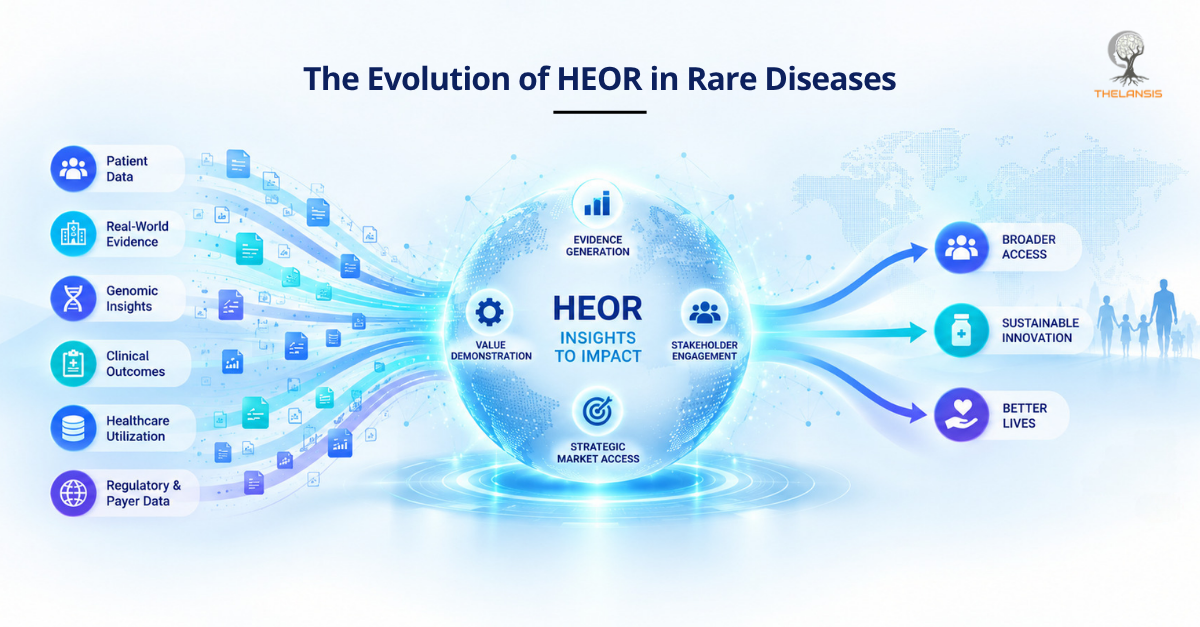
HEOR is increasingly being asked not only to calculate the value of a treatment, but to define what value should include in the first place, and that expanded definition has pulled clinical endpoint selection, comparator strategy, natural-history research, patient-reported outcomes, RWE, economic modeling, payer research, HTA strategy, and post-launch evidence generation into an increasingly interconnected set of decisions. HEOR is therefore moving beyond supporting a reimbursement submission toward shaping the evidence architecture on which market access depends.
Europe is raising the stakes on how that evidence architecture gets judged. Under the EU HTA Regulation, joint clinical assessments began in January 2025 for new cancer medicines and advanced therapy medicinal products. The framework is scheduled to extend to orphan medicinal products from January 2028 and to all new medicinal products within scope by 2030.
For rare-disease developers, this changes evidence planning. Companies will need to consider whether evidence can withstand coordinated European assessment rather than treating national HTA discussions separately. The transition is already visible in practice: in June 2026, the European Commission published its first Joint Clinical Assessment, evaluating Ojemda (tovorafenib), an orphan medicine for pediatric low-grade glioma. Even this first case illustrated the challenge rather than resolving it, reporting on the assessment noted that comparative data existed for only one of eight assessed population-and-comparator combinations, underscoring exactly the kind of evidence gap this piece has been describing. For developers, regulatory approval alone does not resolve the evidence challenge; clinical packages must increasingly be designed with downstream HTA requirements in mind, particularly where small populations, uncertain comparators, surrogate outcomes, and immature long-term data create uncertainty.
Gene and cell therapies push this furthest, because they turn the timing mismatch into a payment problem. A one-time therapy may carry a substantial upfront cost while potentially delivering benefits over many years. The economic model therefore depends heavily on assumptions about durability. But a newly approved therapy cannot come with decades of follow-up.
HEOR teams therefore have to model uncertainty using scenario and sensitivity analyses, natural-history evidence, follow-up, and RWE. At the same time, market-access teams and payers are exploring mechanisms that address the financial consequences of that uncertainty. Outcomes-based agreements, risk-sharing arrangements, and installment-style approaches may help address the mismatch between substantial upfront expenditure and benefits expected to accrue over many years. As a result, how a therapy is paid for is becoming increasingly connected to how its value is demonstrated.
What This Means for the Rare-Disease Market
Rare-disease growth is making evidence strategy increasingly inseparable from business strategy. With orphan medicines projected to represent more than one-fifth of global prescription pharmaceutical sales by 2032, companies cannot afford to treat HEOR as a final-stage function.
Competitive advantage may increasingly belong to companies that understand evidence requirements before pivotal development. That means asking early: Which outcomes matter to payers? What evidence will be missing at launch? Can natural-history data support the analysis? How will uncertainty be modeled? What will HTA bodies challenge?
These are no longer merely reimbursement questions. They are clinical-development, portfolio, pricing, and commercialization questions.
The Next Era of Rare-Disease HEOR
The next evolution of HEOR will not be defined by one model, dataset, or technology. It will be defined by integration. Clinical development, natural-history research, RWE, patient-reported outcomes, caregiver evidence, economic modeling, HTA strategy, pricing, and post-launch evidence generation will increasingly function as parts of the same evidence architecture.
The strongest HEOR strategies will not simply explain value after evidence is generated. They will help determine what evidence needs to exist in the first place, which outcomes should be measured, which uncertainties need to be anticipated, and how the evidence story should evolve throughout the therapy’s lifecycle.
The Real Shift
Rare disease forced the industry to recognize that “does it work?” was never going to be enough. The competitive advantage may no longer belong only to the company with the most effective therapy, but to the company that can build the most credible evidence story around that therapy.