
Sep 07 2026
/
HER2-Positive Metastatic Breast Cancer: The Treatment Shift Reshaping the Market
A Decade of Reinvention
There was a time when a HER2-positive breast cancer diagnosis carried a particularly difficult outlook. The biology was aggressive, treatment options were limited, and metastatic disease was often approached with the expectation of relatively short disease control.
That picture has changed dramatically.
Over the past decade, HER2-positive breast cancer has become one of the clearest examples of what precision oncology can achieve. Trastuzumab transformed HER2-directed treatment, pertuzumab strengthened first-line therapy, antibody-drug conjugates introduced a new way of delivering cytotoxic therapy, and newer combinations have expanded the ability to control disease beyond the breast and into the central nervous system.
Then came another major shift.
In December 2025, the U.S. FDA approved trastuzumab deruxtecan (T-DXd; Enhertu) in combination with pertuzumab for first-line treatment of adults with unresectable or metastatic HER2-positive breast cancer. The decision was based on DESTINY-Breast09 and has effectively changed the starting point for treatment discussions in metastatic HER2-positive disease.
What HER2-Positive Actually Means
HER2, or human epidermal growth factor receptor 2, is a protein involved in cell growth and signaling. In HER2-positive breast cancer, tumors have increased HER2 expression or gene amplification, allowing the HER2 pathway to drive tumor growth.
HER2 status is generally established through immunohistochemistry (IHC) and/or in situ hybridization (ISH). HER2-positive disease is defined by strong HER2 expression or gene amplification according to validated testing criteria.
Hormone receptor status adds another important layer. Some metastatic HER2-positive tumors are also estrogen receptor- or progesterone receptor-positive. These HR-positive/HER2-positive tumors require consideration of both HER2-directed and endocrine treatment strategies.
The distinction matters because metastatic HER2-positive breast cancer is not one uniform disease. Tumor biology, hormone receptor status, previous treatment, metastatic sites, and especially central nervous system involvement can influence treatment selection.
Sizing the Population
The metastatic HER2-positive population remains clinically significant despite major advances in treatment.
According to Thelansis’ patient-based forecast model, the number of newly diagnosed HER2-positive breast cancer cases in the United States is estimated at 77,161 in 2025, rising to 77,767 in 2026 and approximately 83,443 by 2035.
Within the 2025 estimate, approximately 55,145 cases are HR-positive/HER2-positive, while 22,016 are HR-negative/HER2-positive.
The metastatic burden is smaller but strategically important. Stage IV HER2-positive cases are estimated at approximately 6,573 in 2025, increasing to 6,625 in 2026 and 7,108 by 2035.
The numbers themselves do not change dramatically from one year to the next. What is changing much faster is what can be done for patients once metastatic disease is diagnosed.
That distinction is important for the market: relatively stable patient volumes can coexist with substantial shifts in treatment value, sequencing, duration of therapy, and product utilization.
The Treatment Earthquake of December 2025
For more than a decade, the CLEOPATRA regimen established taxane + trastuzumab + pertuzumab as the benchmark first-line approach for metastatic HER2-positive breast cancer.
DESTINY-Breast09 challenged that benchmark.
The phase III study enrolled 1,157 patients with previously untreated HER2-positive advanced or metastatic breast cancer. Patients received either T-DXd plus pertuzumab, taxane plus trastuzumab plus pertuzumab, or an investigational regimen.
The results were difficult to ignore.
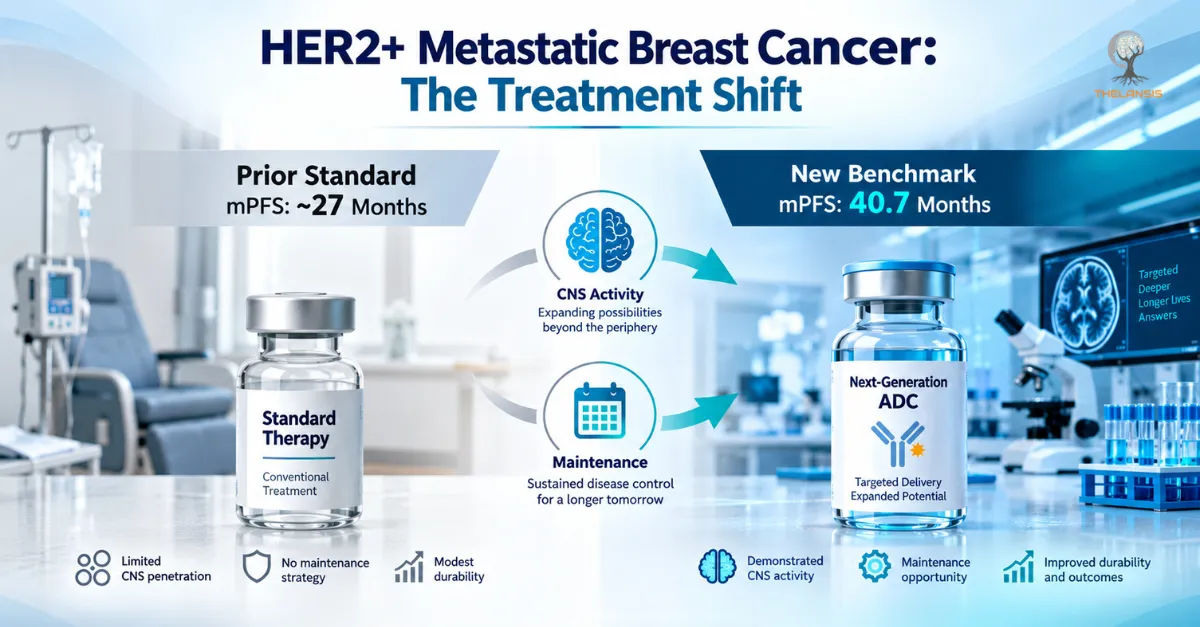
Median progression-free survival reached 40.7 months with T-DXd plus pertuzumab, compared with 26.9 months with taxane + trastuzumab + pertuzumab, corresponding to a hazard ratio of 0.56. The FDA reported a confirmed objective response rate of 87% versus 81%, respectively. Overall-survival data remain immature.
This is more than another positive clinical trial.
It changes the competitive starting point for metastatic HER2-positive treatment.
The question is no longer simply whether an antibody-drug conjugate can outperform conventional HER2-directed therapy later in the treatment journey. The question is how much of the treatment pathway can now be reorganized around an ADC-first strategy.
The Next Puzzle: Life After First-Line T-DXd
Changing first-line treatment inevitably creates another problem: what comes next?
As T-DXd moves earlier in the treatment sequence, clinicians and developers face a more complicated sequencing landscape. Patients who previously received trastuzumab, pertuzumab and a taxane before moving to an ADC may now receive an ADC at the beginning of metastatic treatment.
That creates a potential bottleneck in later lines.
DESTINY-Breast03 established T-DXd as an important treatment after prior trastuzumab and taxane exposure, while newer studies are increasingly exploring combinations and sequencing strategies designed to extend disease control after ADC exposure.
This is becoming one of the most important commercial questions in HER2-positive breast cancer.
The future market may be shaped less by the arrival of a single new drug and more by how companies position therapies around the changing sequence: first-line ADC, subsequent HER2-directed therapy, maintenance strategies, CNS-active regimens, and mechanisms capable of overcoming resistance.
The Brain Metastasis Problem
One of the biggest remaining challenges is the central nervous system.
HER2-positive metastatic breast cancer has a meaningful risk of developing brain metastases, making CNS activity an increasingly important differentiator between therapies.
The HER2CLIMB program helped establish tucatinib as a particularly important option in this setting. The combination of tucatinib, trastuzumab and capecitabine demonstrated clinically meaningful intracranial activity and improved outcomes in patients with HER2-positive metastatic breast cancer, including those with brain metastases.
T-DXd has also demonstrated CNS activity, strengthening the importance of ADCs in a treatment landscape where brain metastases can determine both clinical outcomes and treatment selection.
The implication for future development is clear: systemic efficacy alone is no longer enough. Developers increasingly need to demonstrate meaningful activity against intracranial disease.
Where the Field Is Headed Next
The next phase of HER2-positive treatment is likely to be defined by combinations, maintenance strategies, and more deliberate sequencing.
The PATINA study is particularly important for HR-positive/HER2-positive disease. In June 2026, the FDA approved palbociclib in combination with trastuzumab, with or without pertuzumab, and endocrine therapy as maintenance treatment for adults with HR-positive, HER2-positive locally advanced or metastatic breast cancer following induction treatment. The approval was supported by a randomized study of 518 patients, with a statistically significant improvement in progression-free survival and a hazard ratio of 0.76.
This is an important shift from treating PATINA simply as an investigational question. It demonstrates how the treatment landscape is beginning to move toward maintenance strategies that address both HER2 signaling and hormone-driven disease biology.
At the same time, trials such as DESTINY-Breast07 are exploring whether T-DXd can be further strengthened through rational combinations, including combinations with immune checkpoint inhibition.
The broader direction is clear: the next generation of HER2-positive treatment is unlikely to be defined by single-agent competition alone.
Safety Considerations Unique to ADC-Based Therapy
The growing role of T-DXd also makes safety management increasingly important.
Interstitial lung disease (ILD) and pneumonitis remain key clinically important risks associated with T-DXd and require appropriate monitoring and management.
Cardiac monitoring remains relevant with HER2-directed therapies such as trastuzumab and pertuzumab, while regimens incorporating tucatinib and capecitabine introduce additional toxicities that can affect treatment continuity.
As ADCs move into earlier lines of therapy and patients remain on treatment longer, tolerability becomes more than a clinical consideration. It can influence treatment persistence, quality of life, healthcare utilization, and ultimately the commercial value of a regimen.
2025 Versus 2026: Reading the Market in Real Time
The epidemiology has not undergone an earthquake.
The treatment landscape has.
The estimated number of newly diagnosed HER2-positive cases in the United States increases from approximately 77,161 in 2025 to 77,767 in 2026, while Stage IV cases rise from approximately 6,573 to 6,625.
These are relatively modest changes.
But within the same period, the standard-of-care conversation has shifted substantially following the DESTINY-Breast09 results and the FDA approval of T-DXd plus pertuzumab for first-line metastatic HER2-positive disease.
This disconnect is important for market analysis.
A growing oncology market does not always require a rapidly expanding patient population. In HER2-positive metastatic breast cancer, value can grow through changes in treatment duration, earlier adoption of premium therapies, sequencing, combination strategies, maintenance approaches, and the management of CNS disease.
The commercial opportunity is therefore closely tied to treatment evolution rather than epidemiology alone.
Conclusion
Metastatic HER2-positive breast cancer has moved from one of the more aggressive forms of breast cancer to one of the most actively transformed areas of precision oncology.
Trastuzumab changed the biology of treatment. Pertuzumab strengthened first-line therapy. T-DXd changed expectations around antibody-drug conjugates. Tucatinib demonstrated the importance of CNS-directed efficacy. And the latest first-line and maintenance approvals are now reshaping how the entire treatment pathway is viewed.
The December 2025 approval of T-DXd plus pertuzumab represents one of the most consequential changes in the metastatic HER2-positive treatment landscape in years. The June 2026 approval of palbociclib-based maintenance therapy for HR-positive/HER2-positive disease adds another layer to an increasingly sophisticated treatment sequence.
The next major questions are no longer simply about whether patients can respond.
They are about how long responses can be maintained, how therapies should be sequenced after ADC exposure, which combinations can overcome resistance, how CNS disease can be controlled, and which biomarkers can identify the patients most likely to benefit.
For the market, that means the next decade of HER2-positive metastatic breast cancer is likely to be shaped not just by more drugs, but by increasingly complex treatment pathways.
Source/Disclaimer: This article is intended for informational and educational purposes and does not constitute medical advice. Treatment decisions should be based on current clinical guidelines, approved prescribing information, and individual patient circumstances. Epidemiology figures are based on Thelansis’ HER2-positive metastatic breast cancer patient-based forecast model for the United States, 2025-2035.