
Oct 20 2026
/
Gorlin Syndrome Treatment Burden Problem: What the Patidegib Readout Could Change
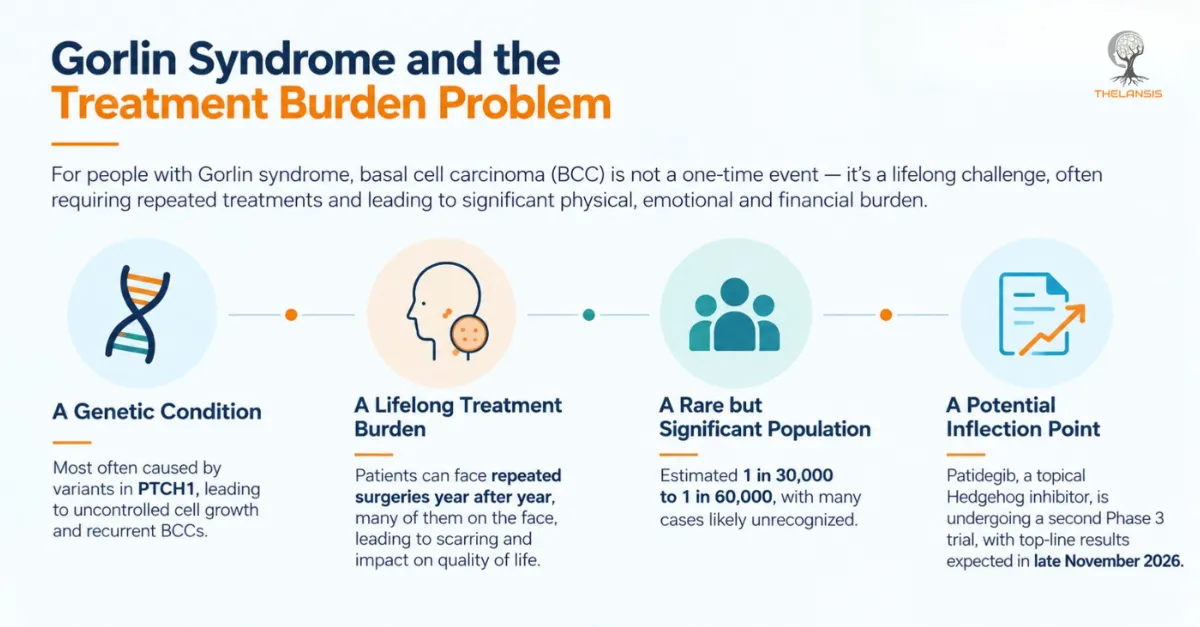
Patients with severe Gorlin syndrome can face repeated surgeries year after year, many of them on the face. Each one can leave a scar, and a face only has so much tissue to spare.
Most people meet basal cell carcinoma (BCC) once: a suspicious spot, a biopsy, a short procedure, and that is usually the end of it. People with Gorlin syndrome meet it again and again. The challenge is not one tumor but a lifetime of them.
The disease sits in a quiet corner of rare disease, but the story around it is not quiet. There is a clean genetic cause, a drug class that works but wears patients out, and a topical gel (patidegib (SGT-610)), that failed a Phase 3 trial in 2021 and is now getting a second pivotal test, with top-line results expected in late November 2026. In February 2026, the field also received its first dedicated treatment guidelines. For market access and evidence teams, the real question is how much treatment burden a new therapy can remove, because that will shape who stays on treatment and what payers will value.
One Gene, One Broken Brake
Gorlin syndrome, also called basal cell nevus syndrome (BCNS) or Gorlin-Goltz syndrome, most often comes from a variant in PTCH1. Loss-of-function variants in this gene are thought to occur in up to 70% of patients who meet diagnostic criteria. Most of the rest involve SUFU, and more rarely PTCH2.
PTCH1 acts as a brake on Hedgehog signaling, a pathway that steers embryonic development and should be mostly quiet in adults. When the brake fails, skin cells receive a constant instruction to divide, and BCCs follow.
Thelansis’ US model splits patients with biomarker information into roughly 71% PTCH1, 8% SUFU and 21% unknown. That fits the literature, and it shows how many patients remain genetically unexplained.
The condition is autosomal dominant, so each child of an affected parent has a 50% chance of inheriting it. Not everyone has a family history, though. Estimates put de novo variants at roughly 20 to 50% of cases, depending on the series.
Published prevalence estimates vary widely with the population studied and how hard researchers looked. Figures from roughly 1 in 30,000 to 1 in 60,000 are often quoted, and some series report lower rates. Milder cases probably go unrecognized, so the true number may be higher. Thelansis’ model estimates 13,876 diagnosed prevalent patients living with Gorlin syndrome in the US, and the feature-level figures below are drawn from that base.
More Than a Skin Disease
BCCs get the attention, but the syndrome follows a timeline. Jaw keratocysts frequently begin in the second decade of life, while BCCs usually appear from the third decade onward. A teenager may see an oral surgeon years before anyone thinks about skin cancer. In Thelansis’ model, keratocysts are the most common feature, affecting about 9900 US patients.
Other features fill in the picture: small pits on the palms and soles, a large head, calcification of the falx cerebri, rib and spine anomalies, and in some patients ovarian or cardiac fibromas. None of these is dramatic alone. Together they are what lets a clinician see a syndrome instead of bad luck.
Genotype shapes the risks. About 5% of children with the syndrome develop medulloblastoma, but the risk is 33% with an SUFU variant against under 2% with PTCH1.
That gap is why a genetic result can decide whether a toddler gets early brain MRI screening. Thelansis’ model lands in a similar place, at roughly 1,000 US medulloblastoma cases.
Radiotherapy deserves its own warning. One guideline summary treats Gorlin syndrome as an absolute contraindication to radiotherapy in children and a relative one in adults, and British guidance advises against it for lesions linked to genetic syndromes like this one. That is a sharp break from how sporadic BCC is handled. Irradiated skin in these patients can sprout large numbers of new tumors inside the treated field, which is why the advice is so firm. Rigorous sun protection matters for the same reason: UV adds to the risk in skin that is already primed.
The Diagnosis Gap
Gorlin syndrome is easy to miss because it looks like ordinary skin cancer at first. European guidance says multiple BCCs before age 20 should trigger a workup for a genetic syndrome, yet young adults with several BCCs are often still treated one lesion at a time. Each lesion gets removed, each pathology report reads the same, and nobody steps back to ask why a 24-year-old is on their fifth.
Genetics adds a wrinkle. A 2026 case series described four patients who clearly met clinical criteria but had mosaic PTCH1 variants that standard blood testing missed. One was a 38-year-old man with metastatic BCC and more than 30 prior lesions. His blood showed nothing, but sequencing a metastatic lymph node revealed a PTCH1 variant that also appeared at under 3% frequency in non-tumor tissue. A negative blood test, in other words, does not always close the question.
Getting the diagnosis right matters beyond the individual. A confirmed result changes surveillance for the patient and opens the door to testing relatives, including children who may need early jaw imaging and, depending on genotype, brain MRI.
How Patients are Treated Today
Treatment burden here means repeated surgeries, scarring, side effects that force patients off therapy, and lifelong cost. For years, care was fragmented. In February 2026, the Journal of the American Academy of Dermatology published the first dedicated BCC guidelines for Gorlin syndrome. They contain 47 recommendations across topical, systemic, surgical and multimodal strategies, plus shared decision-making, monitoring and psychosocial support. The Gorlin Syndrome Alliance says more than 160 clinicians and members of the patient community helped develop them.
One recommendation stands out for pricing and access teams. Recommendation 47 asks clinicians to recognize the lifelong direct and indirect costs patients carry and to reduce them where possible, by choosing lower-cost treatments and seeking financial support.
Between surgery and systemic drugs sit the options patients rarely hear about: curettage, cryotherapy, topical creams and, in selected patients, photodynamic therapy. Each has a place, and each runs out of road when there are dozens of lesions to treat. Visible scarring and constant surveillance also wear on people in ways a lesion count never captures.
Oral Hedgehog inhibitors typically do not appear until the second or third line, with about 2,700 patients on vismodegib and 2,200 on sonidegib. Even then the disease does not stop. About 10,900 patients are still relapsing or refractory after second- or third-line therapy, and only about 435 reach a PD-1 inhibitor in the fourth line. Patients overlap across lines, so these figures should be read as a funnel rather than a sum.
Care starts with local removal and moves toward systemic therapy only after repeated failure, which leaves a large group stuck in the middle. The PD-1 inhibitor cemiplimab was approved in 2021 for advanced BCC after Hedgehog inhibitor failure, but it is aimed at advanced disease, not at the steady stream of new lesions that defines Gorlin syndrome.
The Drugs That Work, and The Price of Taking Them
Because Gorlin syndrome is a Hedgehog disease, blocking Hedgehog was the obvious idea. Vismodegib was approved for advanced BCC in 2012 and sonidegib followed in 2015, both acting on Smoothened, a step in the pathway.
The Gorlin-specific data were hard to ignore. In a randomized trial of 41 patients published in 2012, vismodegib cut the per-patient rate of new surgically eligible BCCs to 2 per year against 29 on placebo, and existing tumors shrank by 65% versus 11%.
The trouble was staying on the drug. In that trial, 54% of patients stopped treatment because of adverse events. The 36-month follow-up was sobering: only five of 40 vismodegib patients tolerated treatment without a break for side effects. Real-world data tell a similar story. A 2024 systematic review of 351 patients reported a 44% complete response rate, with interruptions driven mostly by side effects (69.1%) and secondary resistance (9.1%). Stopping has consequences too, since 11 of 35 patients (31%) who reached complete remission at six months had a recurrence after withdrawal.
The complaints are familiar to anyone who has taken these drugs: muscle cramps, hair loss, altered taste and weight loss, building over months. They are not random. Hedgehog signaling matters in hair follicles, taste buds and muscle, so blocking it there comes with the territory. Both drugs also carry embryo-fetal toxicity warnings, which complicates use in a hereditary disease that often shows up in people of childbearing age.
Sonidegib follows the same pattern. A 2025 Spanish study of 24 patients found 37.5% complete and 54.2% partial responses, yet 83.3% had at least one adverse event, and 13 of the 22 who started at 200 mg daily moved to alternate-day dosing.
For a condition that never goes away, a drug that many patients struggle to stay on has obvious limits. That is why the field turned to a different question: what if the drug only worked where the tumors are?
The Gel That Failed Once
Patidegib is a Hedgehog inhibitor formulated as a gel for the face. The aim is a local effect without the systemic side effects that limit oral drugs.
Early signals were encouraging. A 2017 UK Phase 2 study of seventeen patients, who treated themselves for six months, showed a statistically significant complete-response difference in the per-protocol analysis. In 2019, PellePharm, a BridgeBio affiliate, began Phase 3, planning to randomize about 150 adults to gel or vehicle with new surgically eligible BCCs as the primary endpoint.
Then it failed. In May 2021, PellePharm reported that the trial missed its primary and secondary endpoints, though it showed several signals of potential activity. LEO Pharma ended its option to acquire PellePharm. In many rare disease programs, that would have been the end.
Access the Emerging Therapy, Unmet Needs & TPP Insights Report here: Gorlin Syndrome Emerging Therapy and TPP Insights Report
The Second Attempt
The molecule lived on. It is now with Sol-Gel Technologies as SGT-610, in a new Phase 3 study. Participants apply patidegib gel 2% or a vehicle gel to the face twice a day for 12 months, and new facial BCCs are compared between groups.
The operational numbers are strong. The trial enrolled 113 patients, and 102 completed 12 months of treatment. Eleven patients discontinued, about 10%, which Sol-Gel said was well below its assumptions. Set that beside the 54% dropout seen with oral vismodegib and the logic is easy to see, though the comparison has limits: different drugs, populations and trial designs. Low dropout is not proof of efficacy.
The last patient completed the final study visit on September 17, 2026, and top-line results remain on track for late November. The gel holds FDA Orphan Drug and Breakthrough Therapy designations. It remains investigational, and nothing in this article predicts how the readout will turn out.
Three questions will decide how the readout is judged:
- Is the effect real? Is the reduction in new facial BCCs against vehicle both statistically and clinically meaningful?
- Is it big enough? Oral drugs set a high bar, but a topical gel mainly needs to show it cuts surgical burden in a way patients notice.
- What has changed since 2021? Regulators and clinicians will want to know whether any earlier signals held up.
What it means for market access and evidence teams
- The endpoint has to be translated. A count of new BCCs may satisfy regulators, but payers will ask about surgeries avoided, scarring and quality of life. Patient-reported outcomes on appearance and function may carry unusual weight.
- The gap is in the middle of the funnel. In Thelansis’ model, about 10,900 patients are still relapsing or refractory after second- or third-line therapy, against roughly 4,900 on an oral Hedgehog inhibitor and 435 on a PD-1 inhibitor. These groups overlap, so they describe stages of a funnel, not separate populations. A prevention therapy patients can actually stay on would sit in that gap, if the model’s assumptions hold.
- The comparator is the status quo. No approved topical therapy exists to prevent BCCs in Gorlin syndrome. Topicals such as imiquimod and 5-fluorouracil are used to treat individual superficial lesions, not to prevent new ones. Any new product would be measured against surveillance, surgery and off-label oral inhibitors.
- Persistence drives the market. A therapy patients can stay on for years will reach more of the funnel than one they abandon, which is why the dropout gap between oral and topical Hedgehog inhibition matters commercially as well as clinically.
- Cost and duration of use shape the value story. The guidelines flag lifelong financial burden explicitly, and real-world cost data would strengthen any value case. A therapy meant to be used for years, possibly for life, will be judged on cumulative cost against the surgeries, clinic visits and reconstruction it displaces, not on price per tube.
- Finding patients is its own problem. Many people with Gorlin syndrome are undiagnosed or diagnosed late, so the addressable population in any model is likely larger than what claims data can identify. Genetic testing rates and referral pathways will shape how quickly a new therapy reaches the right people.
The Bottom Line
Gorlin syndrome shows how rare disease development goes in practice: a clear mechanism, a drug class that works but can be difficult to sustain, and a reformulated candidate attempting to solve the treatment-burden problem. With the November readout approaching, the central question is whether local Hedgehog inhibition can reduce the burden of new tumors without creating another long-term burden for patients. Either way, the next phase of Gorlin syndrome care will be shaped not simply by how many patients have the disease, but by how much treatment burden can be removed.
A full patient funnel view, country-specific trends, drug utilization and market uptake are available in the complete Thelansis Gorlin syndrome report and market model.
Note: This article draws on publicly available information, including company announcements and published literature, and on Thelansis’ proprietary epidemiological model. It is intended for informational purposes only and is not investment or medical advice. SGT-610 (patidegib gel) is investigational, and nothing here predicts the outcome of the ongoing Phase 3 trial.