
Oct 01 2026
/
Beyond the Static Document: Why Evidence-Driven TPP Optimization Is Becoming a Strategic Imperative in Pharma
Every drug development program starts with a hypothesis about the product it hopes to become. The Target Product Profile (TPP) is where that hypothesis is written down: the intended indication, the efficacy and safety thresholds, the dosing and administration, and the differentiation the asset needs to earn a place in clinical practice. In many organizations, though, the TPP is drafted early, shaped largely by internal assumptions, and then revisited only at formal governance milestones.
That approach is getting harder to defend. Development costs remain high, competitive pipelines in oncology, immunology, rare disease, and neurology are crowding quickly, and payers are asking tougher questions about comparative value. Clinical decisions made on the basis of an untested TPP can create misalignment that only becomes visible late in development, when changing course is most expensive.
A growing number of R&D, clinical development, and commercial teams are therefore treating the TPP less as a document and more as a strategic instrument that is tested against stakeholder evidence and refined as the landscape changes.
Why TPP Optimization Matters Strategically
A TPP is one of the few artifacts that connects functions that often work in sequence rather than in parallel. Clinical development uses it to design trials and select endpoints. Market access teams use it to anticipate evidence requirements. Commercial teams use it to frame positioning and forecasts. HEOR teams use it to plan economic models and real-world evidence.
When the TPP is well calibrated, these functions work from the same assumptions about what the product needs to deliver. When it is not, each function may be optimizing for a different version of the asset. A trial may be designed around an endpoint that clinicians value but payers discount. A target efficacy threshold may look competitive on paper but fall short of what prescribers consider meaningful in a changing standard of care.
Optimization means testing and refining the profile until the attributes reflect clinical reality, patient needs, payer expectations, competitive dynamics, and commercial objectives together.
From Assumptions to Evidence
Many TPPs are built from internal scientific rationale, early clinical data, and secondary research. That is a reasonable starting point, but it has limits.
Secondary research, including published literature, trial registries, guidelines, and competitor disclosures, shows what has happened and what is publicly known. It is less effective at showing how current prescribers interpret the data, which trade-offs they would accept, or how payers would weigh a new entrant against established therapies. It also lags: by the time a pivotal trial or guideline change is published, the thinking of practicing clinicians may already have moved.
Internal assumptions carry a different risk. Teams close to an asset are often highly informed but can be anchored to the profile they have been working toward. Without outside challenge, it is easy to overestimate how much a modest efficacy gain will matter, or to underestimate the evidentiary burden a payer will require.
Primary insights from Key Opinion Leaders (KOLs) and payers help close these gaps. They turn assumptions into hypotheses that can be tested before significant capital is committed.
The Role of KOL and Payer Insights
KOLs and payers see the same product through different lenses, and a robust TPP needs both.
KOLs, including investigators, specialists, and guideline contributors, can speak to the clinical meaning of a profile. They can help clarify:
- Where unmet need persists despite current therapies, and which patient segments feel it most
- Which efficacy thresholds would change treatment behavior, and which would be seen as incremental
- How safety and tolerability trade-offs would be weighed in real practice
- Which endpoints are clinically credible, and which are unlikely to influence prescribing
- How a candidate would be positioned relative to the existing and emerging standard of care
Payers and access stakeholders add the dimension that clinical data alone cannot supply. They can illuminate:
- What drives perceived value, and what comparators they would expect an asset to be measured against
- The evidence they would require to support coverage, including outcomes data, real-world evidence, or health economic modeling
- Likely access barriers, such as step edits, prior authorization, or budget-impact concerns
- How reimbursement considerations differ across markets and health systems
The two perspectives do not always agree. A clinician may be enthusiastic about an attribute that a payer considers insufficient to justify a premium. Surfacing that tension early is useful, because it is far easier to adjust a development plan than to adjust a launch.
Thelansis’ Evidence-Based Approach
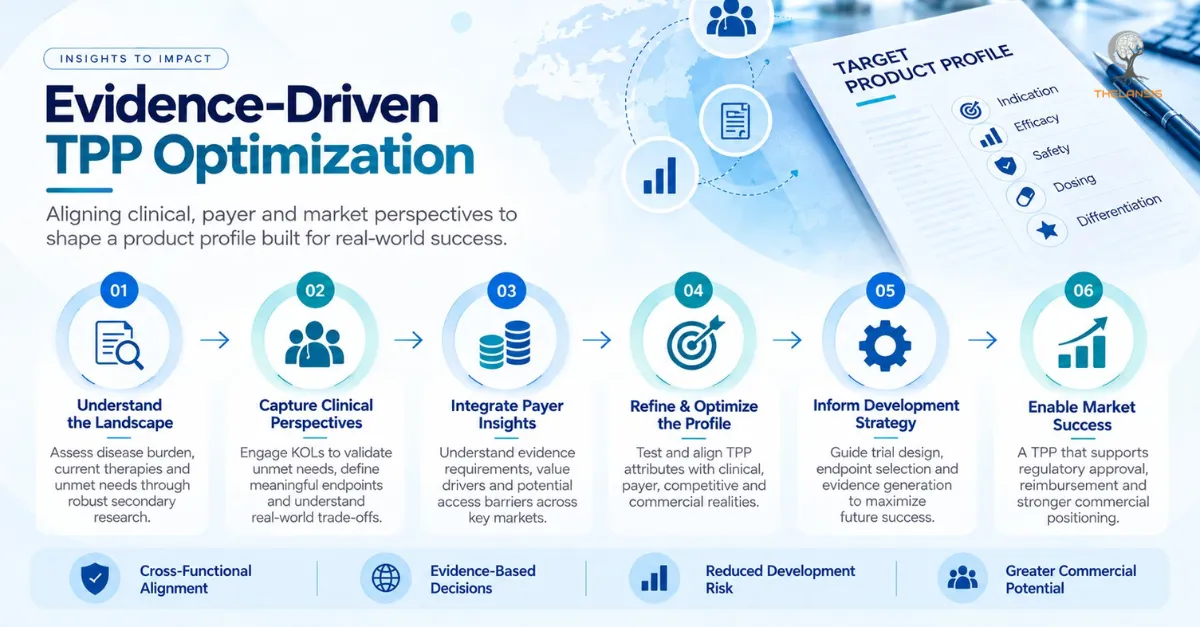
At Thelansis, TPP development and optimization is built on the principle that no single source of evidence is sufficient. Our approach layers several inputs and lets them test each other.
We begin with secondary research to establish the clinical and competitive baseline: disease epidemiology, current standard of care, the emerging pipeline, and the evidence behind competing assets. Because Thelansis works across 20+ therapeutic areas and maintains epidemiology and forecasting capabilities, this foundation connects directly to the size and shape of the addressable patient population rather than sitting apart from it.
We then add primary research, drawing on KOL perspectives and payer insights to test candidate attributes against real-world judgment. Finally, we bring in market intelligence to place the emerging profile in context, benchmarking it against the current and anticipated competitive landscape.
The result is not a single static output. Each attribute in the TPP, from efficacy and safety to dosing and differentiation, is tied to the evidence that supports it, the stakeholders who validated it, and the uncertainty that remains. That traceability makes the profile easier to defend internally and easier to revisit when conditions change.
Best Practices in TPP Optimization Research
Across programs, several practices consistently separate useful TPP research from research that produces interesting but unactionable findings.
- Define the decision-critical attributes first: Not every attribute deserves equal research attention. Focus on those most likely to influence development choices and commercial viability.
- Engage the right mix of stakeholders: Balance clinical specialists, payers, and where relevant, patient and advocacy perspectives, across the geographies that matter to the asset.
- Combine qualitative and quantitative methods: In-depth interviews surface the reasoning behind opinions, while structured quantitative approaches help gauge how widely those views are held.
- Benchmark against competitors: A target is only meaningful relative to what alternatives offer today and what the pipeline may offer by the time the asset launches.
- Test trade-offs, not just preferences: Stakeholders will often say they want better efficacy, a cleaner safety profile, and convenient dosing all at once. Understanding which attributes they would sacrifice for others is what makes a TPP actionable.
- Identify evidence gaps explicitly: The research should show not only where the profile is strong, but where the supporting data is thin and what additional evidence generation would be needed.
- Keep updating: New trial readouts, guideline revisions, and competitor entries can shift the landscape within months. A TPP that is not revisited will drift from the market it is meant to serve.
Turning Stakeholder Evidence into Strategic Decisions
The most common failure in TPP research is not poor data collection but poor translation. Findings are delivered as a set of stakeholder quotes and summary charts, and the team is left to work out what to do with them.
Evidence becomes valuable when it is converted into specific recommendations: which attributes to prioritize, which thresholds to target, which endpoints to emphasize in trial design, which evidence packages to begin building for payers, and where the development plan carries the most risk. A useful output states, for example, that a particular efficacy target appears necessary to differentiate, that a particular safety consideration could limit uptake in a segment, or that payers are likely to expect a specific comparator or outcomes measure.
This is the shift from research as a deliverable to research as a decision tool, and it is central to how Thelansis frames TPP work. Each insight is meant to connect to a development priority.
Applying TPP Optimization Across Development Stages
Because the TPP is a living instrument, its value extends across the asset lifecycle:
- Early asset evaluation: testing whether a candidate’s anticipated profile can realistically meet clinical and market expectations
- Clinical development planning: informing trial design, patient selection, and endpoint choices
- Differentiation strategy: clarifying where an asset can credibly stand apart from established and emerging competitors
- Evidence generation: identifying the clinical, real-world, and economic data that will be needed to support value
- Market access planning: anticipating payer requirements well before submission
- Commercial forecasting: grounding uptake assumptions in validated attributes rather than untested ones
The Commercial and Development Impact
A well-evidenced TPP does not guarantee a successful outcome. Clinical results remain uncertain, and market conditions will continue to change. What it can do is reduce avoidable uncertainty. It helps teams make development decisions with a clearer view of what clinicians and payers are likely to value, supports sharper product differentiation, enables more targeted clinical strategies, and improves alignment between what is being developed and what the market may need when the product arrives.
Conclusion
As development timelines lengthen and competition intensifies, the cost of building on untested assumptions grows. Evidence-driven TPP optimization offers a practical bridge between clinical development, market access, and commercial strategy, one that keeps the profile grounded in the perspectives of the stakeholders who will ultimately determine an asset’s impact.
To learn more about Thelansis’ TPP Analysis and TPP Optimization capabilities. Click here