
Sep 01 2026
/
Defining a Differentiated Target Product Profile (TPP) to Win in a Crowded Therapy Area
Background:
The client was advancing a Phase II biologic in a chronic inflammatory disease category already dense with competition. While early clinical data showed encouraging efficacy and a manageable safety profile, the team faced a familiar challenge: how to stand out in a market where “good data” is no longer enough.
The initial Target Product Profile (TPP) had been developed with a strong clinical lens, largely benchmarked against approved therapies on primary endpoint performance. What it lacked was a forward-looking view of how the treatment landscape and decision dynamics would evolve by the time the asset reached late-stage development and launch. Leadership recognized that without recalibrating the TPP early, downstream clinical, commercial, and access decisions risked being misaligned. That’s where Thelansis came in.
Our Approach:
We worked closely with clinical, commercial, and strategy stakeholders to reposition the TPP as a strategic anchor, not a static development document.
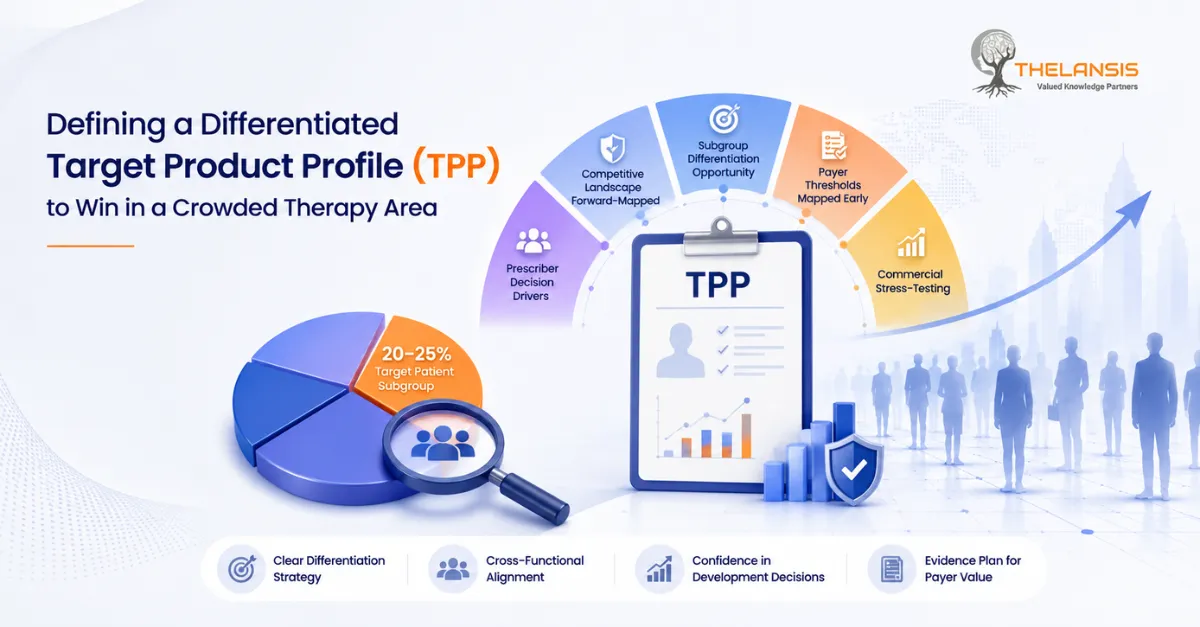
Competitive landscape, forward-mapped:
We began by reassessing the competitive landscape beyond current standards of care, mapping 9 late-stage pipeline assets across three distinct mechanisms of action, with 3 anticipated to launch within 18 months of the client’s projected approval. This meaningfully compressed the differentiation window the original TPP had assumed: a market expected to be roughly 40% more crowded at launch than at the time the original TPP was drafted. The goal was not to chase superiority across every endpoint, but to identify where meaningful differentiation was both achievable and valued.
Prescriber decision drivers, empirically weighted:
In parallel, we analyzed prescriber decision drivers in real-world practice, combining claims-based treatment-switching analysis with structured interviews across 25 community and academic prescribers. This revealed that marginal efficacy differences, the primary axis the original TPP was benchmarked on, explained less than a quarter of observed switching behavior. Durability of response and tolerability in chronic use accounted for the majority of switching decisions, and specific patient-subgroup fit (prior biologic exposure, comorbidity profile) was cited by prescribers as a more decisive factor than head-to-head efficacy claims. These insights exposed an opportunity to position the asset for a defined patient subgroup rather than broadly competing across the full treatment population.
Payer thresholds, mapped early. Payer expectations were integrated early in the process. We assessed likely evidence thresholds for access and found that non-inferiority on the primary clinical endpoint alone was unlikely to secure preferred formulary status: across reviewed payer frameworks in the category, 12-month persistence and healthcare resource utilization data were weighted nearly as heavily as the primary endpoint itself in access decisions. This highlighted that a clearer value story tied to safety, persistence, or resource impact would be essential to securing favorable access.
Commercial stress-testing. Throughout the engagement, early commercial input was used to stress-test the evolving TPP, ensuring it could realistically support future labeling goals, evidence generation plans, and launch strategy.
Outcome:
The engagement resulted in a redefined, future-facing TPP that reflected how the therapy area is expected to look at launch, a landscape roughly 40% more crowded than the original TPP had accounted for, rather than how it looks today.
By shifting the primary differentiation axis from incremental efficacy to durability and subgroup fit, the client moved from competing across the full treatment population to targeting a segment, patients with prior biologic exposure and a specific comorbidity profile, representing an estimated 20-25% of the treated population where existing evidence gaps left room for a defensible value claim.
The client gained:
- A clearer differentiation strategy aligned with prescriber and payer priorities
- Early alignment across clinical, commercial, and access teams
- Greater confidence in Phase II to III development decisions
- A revised evidence generation plan incorporating persistence and resource-utilization endpoints to support the payer value story
Most importantly, the TPP became a practical decision-making tool, guiding development trade-offs and evidence planning from an early stage rather than being revisited reactively at launch.
Why It Matters:
In crowded therapy areas, differentiation rarely happens late. It is built through early, integrated decisions, grounded in where the competitive landscape is heading, what actually drives prescriber choice, and what payers will require for access, not just what the clinical data shows today. This case illustrates how Thelansis helps biopharma teams bridge clinical ambition with commercial and access realities, so assets are designed to compete, not just to advance.