
Sep 07 2026
/
Beyond Market Size: How Patient, Epidemiology & Competitive Intelligence Can Shape Oncology Investment Strategies
Background:
A biopharmaceutical company was evaluating the investment potential of a targeted oncology asset. Initial market assessments appeared attractive. The indication had a sizable patient population, growing scientific interest, and a forecast suggesting meaningful commercial potential.
However, the headline numbers raised an important concern. The total incidence and prevalence did not reflect how many patients would realistically be diagnosed, biomarker tested, eligible for treatment, and reachable within the intended line of therapy. At the same time, the competitive landscape was becoming increasingly crowded, with multiple assets targeting similar patient populations.
The challenge was not simply to determine the size of the market, but to understand where a sustainable opportunity would exist by the time the therapy reached commercialization.
Objective:
The objective was to develop a more realistic investment assessment by combining patient-level epidemiology, treatment dynamics, and competitive intelligence. The team needed to understand how many patients were truly addressable, where patients were lost across the care pathway, and whether meaningful unmet need would remain as the treatment landscape evolved.
Approach:
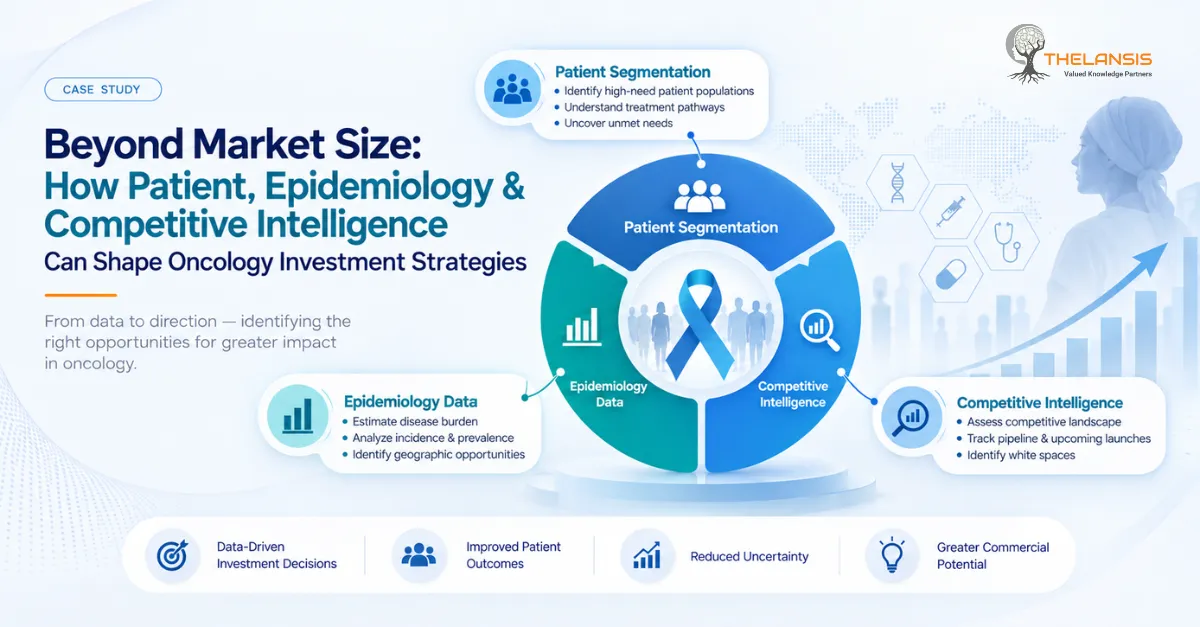
The team conducted an integrated assessment across three areas.
1. Patient and epidemiology intelligence
Rather than relying on topline incidence and prevalence, the patient population was segmented by disease stage, biomarker status, diagnosis rates, treatment eligibility, and line of therapy. This helped distinguish the theoretical patient population from the patients who could realistically be reached.
2. Treatment pathway analysis
The current treatment landscape was mapped to understand how patients moved from diagnosis through different lines of therapy. The analysis examined testing patterns, treatment sequencing, progression, switching, and points where patients remained untreated or continued on suboptimal care.
3. Competitive intelligence
Approved therapies and emerging pipeline assets were assessed alongside anticipated changes in treatment sequencing and standards of care. Particular attention was given to competitors targeting the same patient segment and the potential impact of future market entry on differentiation.
Key Findings:
The analysis showed that the opportunity was more nuanced than the original market-sizing exercise suggested. Of the total diagnosed population, only an estimated 55-60% underwent biomarker testing within a clinically actionable window, and of those testing positive, roughly one in five were lost between testing and treatment initiation due to referral delays and site-of-care fragmentation. By the time these gaps were accounted for, the truly addressable population in the intended line of therapy was approximately 30-35% smaller than the topline prevalence estimate implied.
Meanwhile, the competitive landscape indicated increasing pressure within the most obvious commercial segment: five additional assets targeting the same biomarker-defined population were in Phase 2/3 development, with two anticipated to reach the market within a similar commercialization window.
However, the analysis also identified a smaller but strategically important patient group, those progressing after first-line treatment with limited durability of response, that represented an estimated 15-18% of the treated population but faced only one late-line option with modest efficacy data. This group showed disproportionately high unmet need relative to its size, and no competing pipeline asset in Phase 2 or later was positioned to directly address it.
This unmet need was not immediately visible through epidemiology or market size data alone.
Impact:
The integrated assessment helped the company move beyond a single market-size estimate and build a more realistic investment thesis. Combining epidemiology, treatment pathway, and competitive intelligence narrowed the addressable population estimate by roughly a third, while identifying a smaller segment with meaningfully higher unmet need and materially lower competitive density, shifting the investment conversation from overall market size to where a defensible, differentiated position could actually be built.
Conclusion:
In oncology, the largest patient population is not always the most attractive investment opportunity. A meaningful opportunity emerges from understanding which patients can realistically be identified and treated, where current care continues to fall short, and how the competitive landscape is likely to evolve.
By combining patient intelligence, epidemiology, and competitive analysis, the team shifted the strategic question from “How big is the market?” to “Where will meaningful unmet need and differentiation still exist?” That shift provided a more credible foundation for oncology investment and commercialization strategy.