
Sep 28 2026
/
Trends in HEOR: What Payers and HTA Bodies Are Asking for Now
A therapy can clear every regulatory hurdle and still face difficult questions at the formulary or reimbursement stage. That gap between regulatory approval and patient access is where health economics and outcomes research (HEOR) increasingly matters.
Clinical trial results remain fundamental, but healthcare decision-makers need more than evidence of efficacy and safety. Payers and health technology assessment (HTA) bodies increasingly need to understand how a therapy performs in routine practice, what it means for healthcare budgets, how it compares with existing standards of care, and whether it addresses a meaningful unmet need.
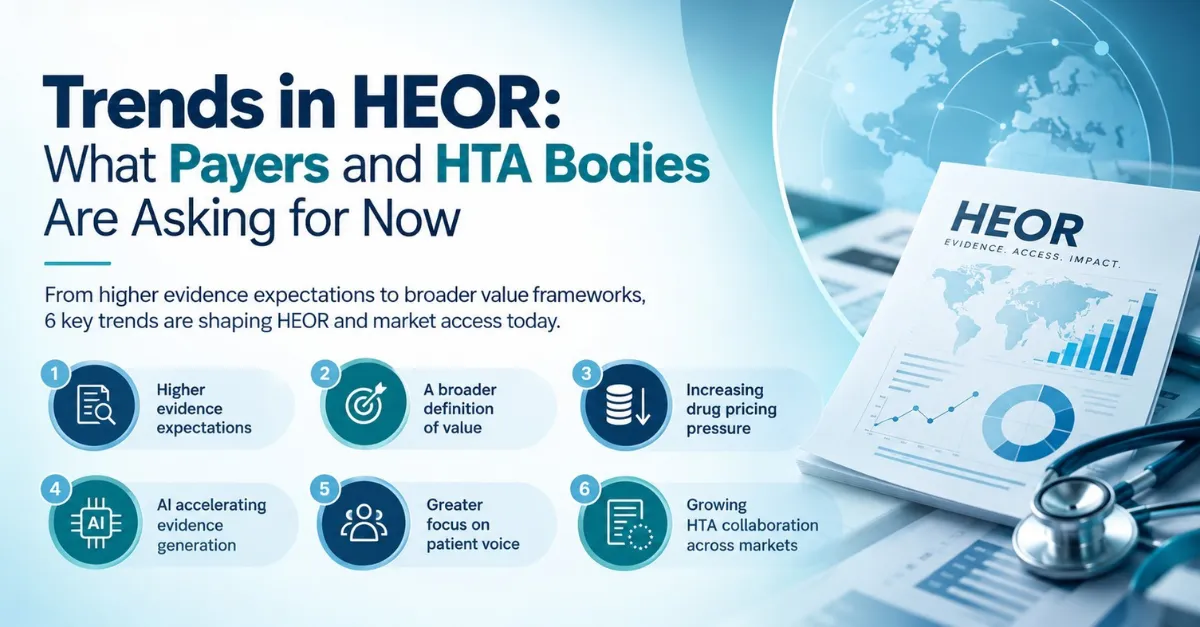
At the same time, the HEOR landscape is changing. Real-world evidence is becoming more important, value assessment is becoming broader, pricing pressure continues across healthcare systems, patient perspectives are receiving greater attention, and artificial intelligence is beginning to reshape how evidence is generated and analyzed.
For pharmaceutical and biotech teams, these changes point to a broader shift: HEOR is moving further upstream in the development process and becoming more closely connected to evidence strategy, market access, pricing, and lifecycle planning.
Why HEOR matters more than it used to
Clinical proof gets a therapy approved. HEOR evidence gets it paid for, prescribed, and kept on formulary. Six shifts explain why the bar keeps rising:
- Evidence expectations keep climbing. Payers and HTA bodies increasingly ask for evidence beyond what regulators require, and the specific gap differs by category. Small populations make traditional RCT evidence harder to generate in rare disease; high-volume chronic and specialty categories face intense comparative and long-term outcomes scrutiny instead. RWE has become the connective tissue for both. In an ISPOR-presented review of NICE single technology appraisals, real-world evidence supported the value demonstration in 44 of the appraisals studied, and directly shaped the committee’s opinion in nearly one in five of those cases.
- Value itself is being redefined. HTA bodies are expanding value frameworks beyond clinical and economic endpoints to include equity, unmet need, productivity, and whole-health factors. A narrower “cost per QALY” dossier no longer covers the conversation. NICE’s severity modifier is a clear example: introduced in 2022 to give more weight to treatments for more severe conditions, it was applied in roughly 30% of eligible single technology appraisals in the 12 months to May 2024 (per an ISPOR 2024 analysis), and NICE’s board confirmed in September 2024 that it’s working as intended.
- Drug pricing pressure is intensifying globally. From most-favored-nation policy debates in the US to external reference pricing across Europe, sponsors need value-based pricing models and risk-sharing structures backed by defensible HEOR analysis, list-price justification alone doesn’t hold up anymore.
- AI is changing the speed of evidence generation, not the need for rigor. Literature reviews and data structuring can move faster. Model conceptualization, evidence interpretation, and payer-facing value stories still can’t be automated away; they need expert judgment behind them.
- Patient voice has become a submission requirement. Regulators and HTA bodies are formalizing patient experience data into review pathways, particularly in rare disease, where patients and caregivers are often the most reliable source of real-world burden-of-illness data. The FDA’s Patient-Focused Drug Development guidance series, mandated under the 21st Century Cures Act, now sets out a defined, multi-part methodology for collecting and submitting this data, moving it from a nice-to-have into an expected part of the evidence package.
- HTA collaboration is raising the global evidence bar. With frameworks like the EU’s Joint Clinical Assessments (JCA) bringing a shared HTA review process across EU member states into effect for oncology therapies and advanced therapy medicinal products (ATMPs) starting in 2025, a single evidence package increasingly has to satisfy multiple health systems at once. That raises the cost of getting the evidence plan wrong the first time.
Across the 20+ therapeutic areas we work in, none of this is theoretical. It shows up as small patient populations and immature real-world datasets in rare disease, or as intense payer scrutiny and competitive pressure in high-volume chronic and specialty categories. Closing that gap, wherever an asset sits, is what Thelansis’s HEOR practice is built to do.
Our framework: a stage-wise deliverable map
Evidence needs to shift at every stage of an asset’s life.
1. Early Development — Pre-Clinical to Phase II “Is there a viable value story, and what evidence will we need to prove it?”
- Early evidence gap analysis
- Target Product Profile (TPP) input from a payer/HTA lens
- Disease burden modelling
- Preliminary economic model conceptualization
2. Late-Stage Development — Pre-Launch “What does the evidence package need to look like to secure access on day one?”
- Full systematic literature review and evidence synthesis
- De novo economic model build (CEA / CUA / BIM)
- RWE study design and feasibility assessment
- Global value dossier development
- Payer and HTA landscape mapping by target market
3. Launch — How do we translate the evidence into a value story that lands with each stakeholder?
- HTA submission support and country-specific model adaptation
- Payer value communication tools and objection-handling evidence
- Advisory board and KOL engagement materials
- Pricing and access strategy input, including value-based pricing
4. Post-Launch — Lifecycle Management “Is the evidence still defensible, and where are the gaps competitors or payers will exploit?”
- Real-world evidence generation and outcomes tracking
- Model updates for new comparators, indications, or geographies
- Competitive value positioning updates
- Re-submission and formulary defense support
The questions we’re built to answer, at every stage
- What is the true unmet need and disease burden in our target markets?
- What clinical and economic evidence will payers and HTA bodies actually demand — not just what regulators require?
- How does our asset’s value compare once modeled against the real standard of care in each market?
- Where are our evidence gaps, and how costly are they to close versus ignore?
- How do we translate a scientifically sound model into a value story a payer committee will actually act on?
HEOR is moving earlier in the asset lifecycle
HEOR is no longer simply a set of analyses performed shortly before an HTA submission. The strongest evidence strategies start earlier, when teams are defining the target product profile, selecting endpoints, considering comparators, assessing unmet need, planning RWE, and thinking about how value will ultimately be assessed. That does not mean every asset needs the same evidence package, requirements depend on the indication, development stage, target markets, treatment landscape, data availability, and decision-maker.
What is changing is the timing of the conversation. The question is no longer only whether an asset works. It is whether the evidence being generated will be sufficient to demonstrate its value when healthcare decision-makers have to make real-world choices about access, reimbursement, and resource allocation. That is where a well-planned HEOR strategy can make a difference.
At Thelansis, we work across the asset lifecycle to help life sciences teams identify evidence gaps, generate decision-relevant insights, and build evidence strategies aligned with the needs of payers and HTA stakeholders.
Looking to pressure-test your evidence plan against what payers and HTA bodies are asking for today? Get in touch with our HEOR team to talk through where your asset stands.