
Jul 30 2026
/
Market Access Doesn’t Begin After Approval. It Begins with Evidence
Why the most successful commercial launches are built long before reimbursement discussions begin
For years, market access has been treated as a milestone. From developing the therapy, to completing the clinical trials and securing regulatory approval. Then prepare for pricing, reimbursement, and payer negotiations.
While that sequence may still describe the formal development pathway, it no longer reflects how successful commercialization actually happens.
Across oncology, rare diseases, cell and gene therapies, and specialty medicines, the expectations placed on innovators have evolved considerably. Regulators determine whether a therapy can reach the market, but payers, HTA agencies, providers, and healthcare systems ultimately determine how broadly patients can access it. That shift has changed the role of market access.
It is no longer a downstream activity. It is a strategic capability that influences clinical development, evidence planning, pricing strategy, and commercial execution from the earliest stages.
Organizations that recognize this shift tend to enter launch with a clearer value narrative, stronger evidence packages, and fewer surprises during reimbursement discussions.
Those that don’t often find themselves trying to answer questions that should have been addressed years earlier.
Why Clinical Success Alone Is No Longer Enough
A therapy may demonstrate meaningful clinical benefit and still encounter significant barriers to market access. This is rarely because the science is weak.
More often, it is because the evidence generated during development does not fully answer the questions that healthcare decision-makers need answered.
Payers increasingly evaluate therapies through a broader lens.
They want to understand:
- Which patients derive the greatest benefit?
- How durable are the outcomes?
- What economic burden can be avoided?
- How will this therapy fit within existing treatment pathways?
- Is the incremental value sufficient to justify reimbursement?
These questions extend well beyond efficacy and safety. They require clinical evidence, health economic analyses, real-world data, epidemiological context, and a clear understanding of healthcare system priorities.
This is why market access planning has become closely connected with evidence generation rather than following it.
Market access starts long before reimbursement discussions begin. Organizations that integrate evidence planning, HEOR, pricing, reimbursement, and HTA strategy early are better positioned for successful commercialization. Explore how our Market Access Consulting Services help biopharma companies build payer-ready strategies from the earliest stages.
Thinking Beyond Launch
Commercialization should not be viewed as a sequence of disconnected activities owned by different departments.
Clinical development, medical affairs, market access, HEOR, epidemiology, commercial teams, and external stakeholders all contribute to a single objective: demonstrating value in a way that is meaningful for each decision-maker.
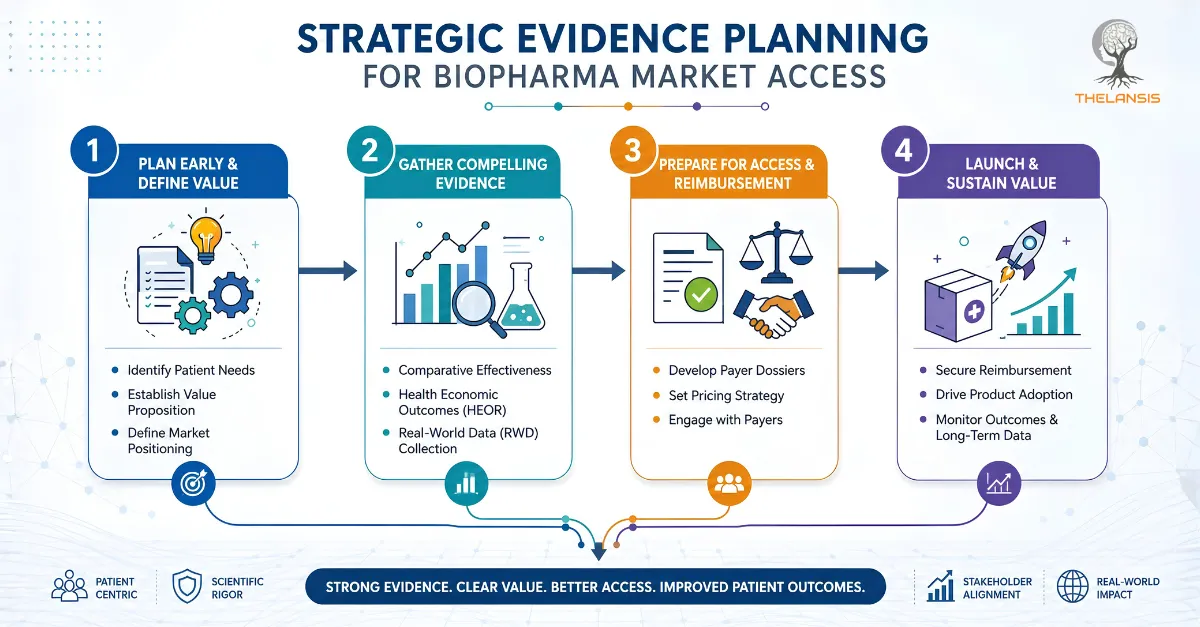
A practical way to think about this journey is through five connected stages
Stage 1: Build the Right Evidence, Not Just More Evidence
Evidence generation often focuses on satisfying regulatory requirements. Commercial success requires a broader perspective.
Beyond pivotal clinical trials, organizations increasingly need epidemiology insights, burden-of-illness studies, treatment pathway analyses, patient-reported outcomes, and real-world evidence that reflects routine clinical practice.
The objective is not simply to collect additional data. It is to generate evidence that answers the questions payers, HTA bodies, clinicians, and healthcare systems will eventually ask.
Companies that begin this process early often have greater flexibility to incorporate evidence objectives into clinical development rather than attempting to fill critical gaps after approval.
Stage 2: Define a Value Proposition That Resonates Across Stakeholders
Value is rarely interpreted in the same way by every stakeholder.
- A clinician may prioritize improved clinical outcomes
- A payer may focus on budget impact and long-term cost offsets
- An HTA agency may emphasize comparative effectiveness and cost-effectiveness
- Hospital administrators may evaluate operational efficiencies or resource utilization
Each perspective is valid. The challenge lies in developing a value proposition that remains consistent while addressing these different priorities.
Organizations that begin stakeholder mapping early are often better positioned to shape evidence generation, messaging, and market access strategy around the questions that matter most.
Stage 3: Prepare for Market Access Before Launch
Market access planning extends far beyond reimbursement submissions.
It involves understanding country-specific payer expectations, evaluating pricing scenarios, developing HEOR models, identifying evidence gaps, engaging key stakeholders, and preparing for health technology assessments.
Waiting until regulatory approval to address these activities frequently compresses timelines and limits strategic flexibility.
Early preparation creates opportunities to anticipate challenges rather than react to them.
It also allows cross-functional teams to align around a common commercialization strategy before launch.
Stage 4: Commercial Success Depends on Organizational Alignment
Even the strongest evidence package can lose momentum if commercial execution lacks coordination.
Medical affairs, market access, commercial teams, regulatory, and external partners should not be working toward independent objectives.
Successful launches typically demonstrate strong alignment across functions, with each team reinforcing the same value narrative while tailoring communication for different audiences.
Key opinion leaders, patient advocacy organizations, and scientific experts also play an important role, not as promotional channels, but as contributors to clinical understanding and healthcare dialogue.
Consistency across these interactions strengthens credibility throughout the launch process.
Stage 5: Market Access Continues After Reimbursement
Receiving reimbursement is not the end of the commercialization journey.
Healthcare systems evolve, competitive landscapes change, new evidence emerges, pricing policies shift, patient outcomes become measurable in real-world settings.
Organizations that continue generating evidence after launch are better positioned to maintain reimbursement, respond to reassessments, support label expansions, and reinforce the therapy’s value over time.
Lifecycle evidence generation has become an increasingly important component of long-term commercial success.
Bringing the Pieces Together
Viewed individually, each of these activities appears manageable. The challenge arises when they are approached in isolation.
- Evidence generation becomes disconnected from commercial planning
- HEOR is developed independently of epidemiology
- Pricing strategy evolves separately from clinical development
- Commercial teams inherit a value proposition they had little role in shaping
The organizations that consistently execute successful launches tend to connect these activities through a single commercialization strategy.
Rather than asking, “What do we need for launch?” they ask a broader question:
“What evidence, insights, and stakeholder engagement will demonstrate value throughout the product’s lifecycle?”
That shift in thinking often determines whether market access becomes a hurdle, or a competitive advantage.
As therapies become increasingly specialized and healthcare systems continue to emphasize value-based decision-making, organizations that integrate evidence generation with market access strategy from the outset will be better equipped to navigate complex reimbursement environments and deliver meaningful patient access.
Ultimately, sustainable commercial success is rarely achieved through a single milestone.
It is built through a series of deliberate, interconnected decisions, from generating the right evidence to communicating value long after launch.
Explore our Market Access Consulting Services to see how we can support your next product launch.