
Aug 13 2026
/
How Patient Journey Analytics Improves Drug Commercialization
A drug’s clinical trial data tells you how it performs under ideal conditions. It doesn’t tell you where your patients actually are, why they’re taking three years to get diagnosed, which physicians are missing them entirely, or where they’ll fall out of the funnel between prescription and first fill. That gap between what the label promises and what happens in the real world is where commercialization strategies succeed or quietly fail.
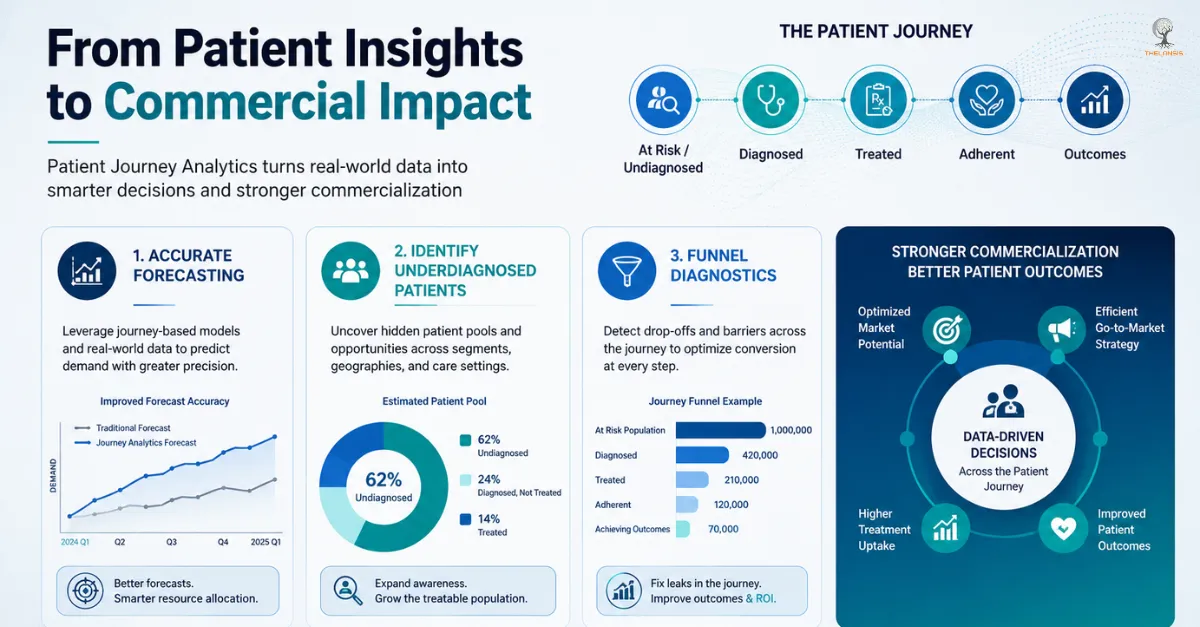
Patient journey analytics closes that gap. It reconstructs the full path a patient takes from first symptom, through diagnostic odyssey, to diagnosis, treatment initiation, therapy switching, and long-term adherence using claims data, electronic health records, specialty pharmacy records, lab and genomic data, and increasingly, unstructured clinical notes.
For commercial teams, it’s no longer a “nice to have” alongside traditional market research. It’s the analytical backbone connecting launch strategy, forecasting, field deployment, and payer negotiations to what is actually happening to patients.
Why it matters more now than ever
Three forces have made patient journey analytics central to commercialization:
- Smaller, harder-to-find patient populations: Oncology and rare disease launches increasingly target biomarker-defined subgroups, such as, patients with a specific fusion, mutation, or genomic signature. Traditional epidemiology gives you a prevalence estimate. It won’t tell you which physicians are ordering the right tests, or where diagnosed-but-untreated patients are sitting today.
- Forecasts built on assumptions collapse fast. When market sizing relies on survey-based recall of “typical” patient flow rather than actual claims and EHR-derived treatment patterns, brand teams routinely overstate the addressable population, and then have to explain a launch miss to leadership.
- Payers now demand real-world evidence, not just trial data. Formulary and pricing conversations increasingly hinge on demonstrated treatment patterns, discontinuation rates, and outcomes in real practice and not just what happened in a controlled trial population.
What good patient journey analytics actually delivers
- Accurate, evidence-based forecasting — replacing recall-based market sizing with claims- and EHR-derived patient flow, so budgets and sales targets are grounded in what’s actually happening, not survey artifacts.
- Patient-finding for underdiagnosed and rare conditions — identifying diagnosed-but-untreated patients, or patients with symptom clusters suggestive of an undiagnosed condition, so field and medical affairs teams know where to focus.
- Funnel diagnostics — pinpointing exactly where patients abandon a therapy: at prior authorization, at first fill, at the specialty pharmacy handoff, or during early-cycle discontinuation, so interventions can be targeted rather than generic.
- HCP and referral network mapping — tracing how patients actually move between primary care, specialists, and treatment centers, which often reveals influence patterns very different from a standard KOL list.
- Access and equity insight — surfacing structural barriers, like distance to an infusion center or lack of transportation, that no amount of physician detailing will fix on its own.
A real-world example
Cholangiocarcinoma, a rare bile duct cancer, is diagnosed in only a few thousand patients a year in the US, and a meaningful share carries the FGFR2 fusion that a targeted therapy is built to treat. When QED Therapeutics brought infigratinib toward commercialization, the challenge wasn’t proving the drug worked; it was finding the right patients in a population this small and this hard to diagnose. The company paired a companion diagnostic (built with Foundation Medicine to detect FGFR2 fusions) with precision analytics to identify eligible patients and map the diagnostic and treatment pathways they were actually moving through, rather than relying on assumed prevalence figures.
The same discipline shows up in less headline-grabbing but equally consequential ways. In hematology, patient journey analysis has been used to identify thousands of patients living far from infusion centers with limited transportation, a barrier invisible in a standard epidemiological model, but one that directly determines whether an eligible patient ever starts therapy. Once that barrier is visible, it becomes something a commercial or patient services team can actually solve, rather than an unexplained gap in uptake.
The common thread: in both cases, the analytics didn’t just describe the market. They changed what the commercial team decided to do.
Where this fits into the broader commercialization toolkit
Patient journey analytics works best when it isn’t siloed from the rest of the evidence and market intelligence function. The most defensible forecasts sit on epidemiological models that are cross-validated against registry and claims data. The most useful access strategies pair patient-level barriers with a clear read of the competitive and payer landscape. And the most credible payer conversations combine real-world treatment pattern data with a coherent value narrative.
That’s the intersection we work in at Thelansis. Whether it’s building epidemiological models that hold up to scrutiny at the country level, mapping treatment decision pathways for a therapeutic area, or profiling the commercial and payer landscape a launch will land into, the goal is the same: replace assumption with evidence, early enough that it actually changes the strategy, not just documents it after the fact.
Patient journey analytics isn’t about generating another dashboard. It’s about answering a much simpler question that every commercialization plan ultimately depends on: where exactly are the patients and what’s standing between them and the therapy that could help them?
The bottom line
Trial data proves a drug can work. Patient journey analytics is what tells a commercial team whether it will actually reach the patients it was built for, and where to intervene if it won’t. As therapies get more targeted and payers get more demanding, that evidence isn’t a differentiator anymore; it’s the baseline cost of a credible launch plan.