
Nov 07 2026
/
Five Commercialization Mistakes Biotech Companies Make Before Launch (And a Checklist to Avoid Them)
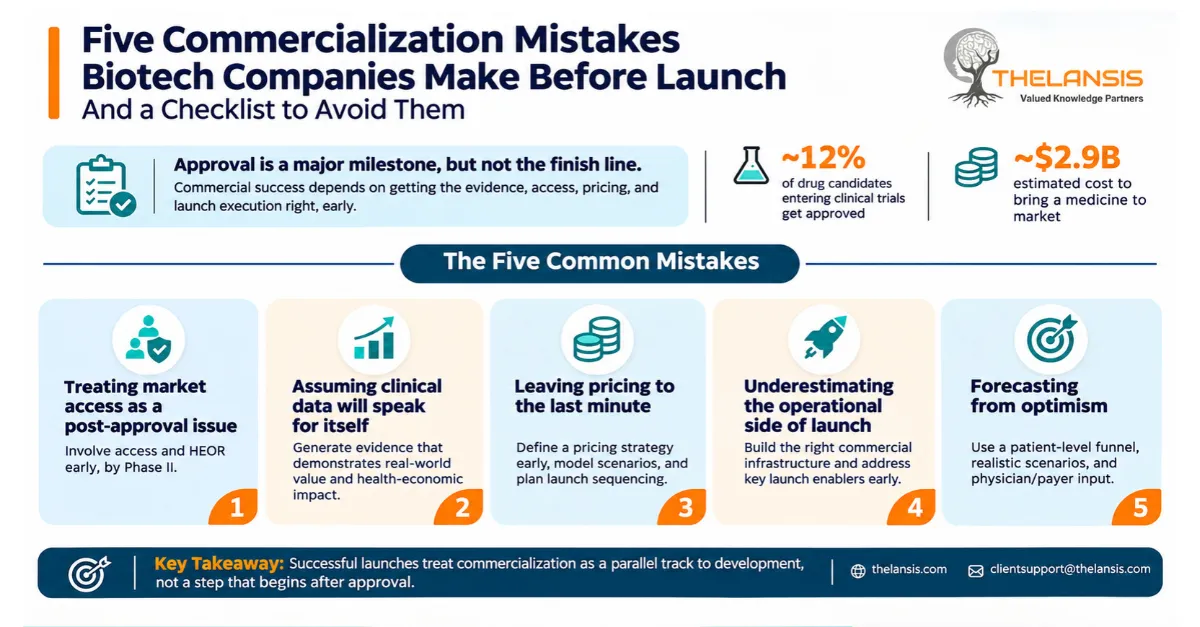
Getting a drug approved is brutal. According to Tufts CSDD, only about 12% of drug candidates that enter clinical trials are ultimately approved, and CSDD’s analysis put the full lifecycle cost of bringing a medicine to market at roughly $2.9 billion (capitalized, 2013 dollars). Either way, the message is the same: getting to approval takes enormous time, capital, and risk. So when a biotech finally has the approval letter in hand, it’s natural to think the hard part is over.
In our experience, it usually isn’t. Regulatory approval answers whether a medicine can be marketed and not whether the evidence, pricing, access model, and commercial infrastructure are ready to support adoption. At Thelansis, we work at the intersection of market access, HEOR, and drug development, and we keep seeing the same five mistakes.
1. Treating market access as a post-approval problem
The thinking goes: get the label first, talk to payers later. By then the pivotal trial is locked and the comparator decision is history. But payers don’t only read your label, they read your evidence package. If Phase 3 didn’t include the comparator, outcomes, or population they care about, no amount of polish on the launch deck fixes that.
What we recommend: Bring access and HEOR expertise in by Phase 2, earlier if possible. In the EU, a Joint Scientific Consultation lets you get regulators and HTA bodies to weigh in on your evidence plan while there’s still time to change it.
2. Assuming clinical data will speak for itself
“We hit the primary endpoint” starts the value conversation, it doesn’t finish it. Payers and HTA agencies ask: better than what, for whom, at what cost to the system? A statistically significant result that doesn’t translate into a measurable outcome (avoided hospitalizations, QALYs gained, downstream savings) tends to get a lukewarm reception, and gaps in demonstrated value are a common contributor to prior authorization and step-edit restrictions.
This is getting more, not less, important: under the EU HTA Regulation, joint clinical assessments began on 12 January 2025 for new cancer medicines and advanced therapies, with orphan medicines joining in 2028 and all new centrally authorized medicines in 2030. The assessment covers relative clinical effectiveness only, pricing and reimbursement stay national, but it means your evidence increasingly feeds one joint EU-level review rather than a different story in each market.
What we recommend: Build the evidence plan early, a cost-effectiveness/cost-utility model, a budget impact model payers can adapt to their own population, a real-world evidence and PRO strategy, and an indirect treatment comparison where head-to-head data doesn’t exist.
3. Leaving pricing to the last minute
We’ve seen pricing decided in the final months by a small group and a spreadsheet, risky, given how much it echoes across markets. International reference pricing means a low price in one country can pull prices down elsewhere, which is why launch sequencing matters. In the US, the Inflation Reduction Act adds another layer: small-molecule drugs become eligible for Medicare price negotiation seven years after approval, biologics eleven. The rules keep shifting, too. The 2025 reconciliation bill (the One Big Beautiful Bill Act) widened the orphan-drug exclusion to cover drugs designated for multiple rare diseases and started the negotiation clock at first non-orphan approval, which changed the calculus for indication-sequencing strategy in rare disease.
What we recommend: Develop pricing alongside the value story, not after it. Model scenarios across markets, map reference-pricing relationships, and choose launch order deliberately.
4. Underestimating the operational side of launch
A great drug still has to reach a patient: speciality pharmacy and distribution agreements, a patient hub, reimbursement support, medical affairs, field teams, trained sites, data systems. Some companies overbuild early and burn cash before access is secured; others underbuild and can’t get product to patients fast enough. Either way, the first six months set the tone, and early execution gaps are hard to recover from.
What we recommend: Decide early what you’ll build, partner on, or outsource. Run a launch-readiness review about a year out and be honest about the gaps; a first-time launcher isn’t the same as a company that’s done this five times, and the plan should account for that.
5. Forecasting from optimism
Many forecasts start with a big epidemiology number and apply a hopeful market share. It’s neat, and it’s how forecasts end up wildly off. According to a published research, pharma launches between 2016 and 2020 found that first-time launchers reached a median of just 63% of their pre-launch sales forecast, compared with 93% for experienced launchers, and that only 39% of first-time launches beat forecast at all, versus nearly half for experienced companies. Real-world friction such as, undiagnosed patients, diagnosed-but-untreated patients, physician inertia, payer restrictions, discontinuation chips away at the top-line number every time.
What we recommend: Forecast patient-by-patient through the funnel (diagnosed → eligible → treated → adherent), use ranges rather than a single number, and pressure-test assumptions with real physician and payer input.
Pre-launch checklist
Before we would call a launch commercially ready, we would want a clear “yes” to the following:
Evidence & Access
- Market access and HEOR are involved by at least Phase II
- Payer and HTA perspectives have informed evidence planning
- Key evidence gaps have been identified before pivotal design is locked
- A cost-effectiveness or cost-utility model is planned or ready, where relevant
- A budget impact model is ready for priority markets
- A real-world evidence and PRO strategy is in place
Pricing & Market Strategy
- The value proposition is differentiated by stakeholder
- Pricing has been tested across priority markets
- International reference-pricing relationships have been mapped
- Launch sequencing is a deliberate strategic decision
- Relevant policy and lifecycle considerations have been incorporated into the pricing strategy
Commercial Operations
- Distribution and fulfillment are mapped
- Patient-support requirements are defined
- Reimbursement-support processes are ready
- Medical affairs and commercial capabilities are in place
- Priority treatment centers and provider requirements are understood
- Internal versus outsourced capabilities have been clearly defined
Forecasting & Readiness
- The forecast is bottom-up rather than purely epidemiology-driven
- Key assumptions are documented
- Base, upside, and downside scenarios have been tested
- Physician and payer assumptions have been pressure-tested with primary research
- A formal launch-readiness review is scheduled approximately 12 months before launch
- The most important launch risks have owners and mitigation plans
Final thought
Almost all of these mistakes come from the same place: treating commercialization as the step after development instead of something that runs alongside it. The teams that launch well are usually the ones that asked the uncomfortable questions early, while there was still time to act on the answers.
If you’re preparing for launch and want a second set of eyes on your evidence plan, pricing approach, or access strategy, the Thelansis team would be glad to talk it through.