Aug 30 2026
/
ESMO 2026 Preview: What the Abstracts Reveal Before the Data Drops
Every major oncology congress has its headline moments: a trial that changes practice, a therapy that exceeds expectations, or a new mechanism that suddenly becomes the industry’s next big focus.
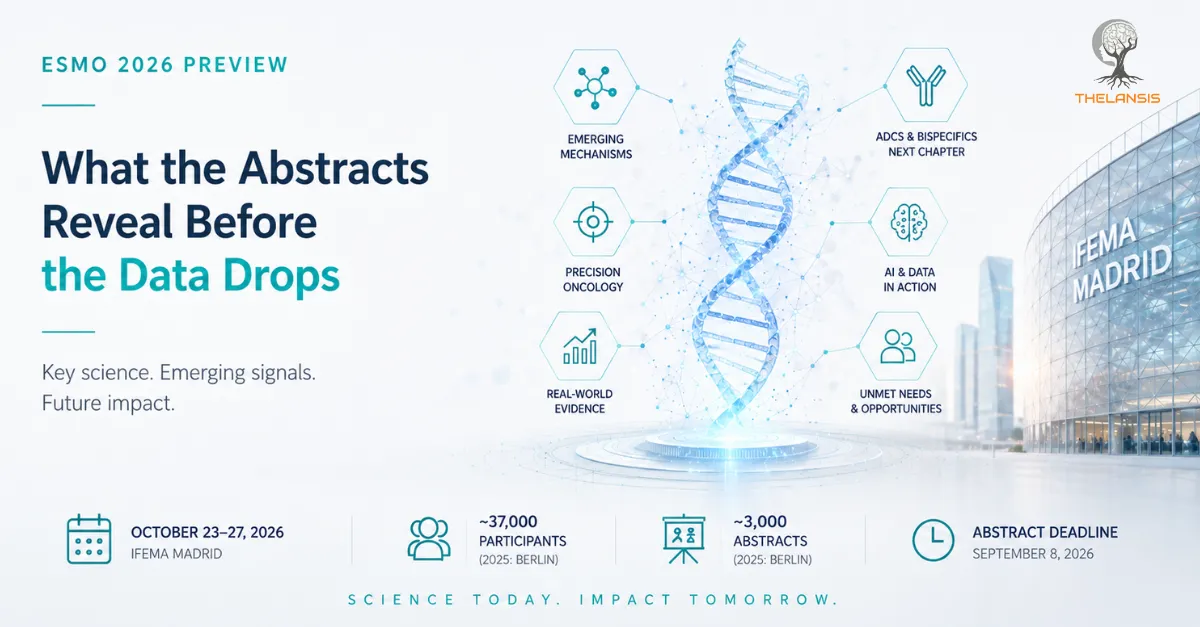
But ESMO is rarely just about individual trial results. It is where the oncology community gets an early view of which scientific ideas are gaining momentum, which treatment approaches are becoming crowded, and where the next competitive opportunities may emerge. This year, that view will unfold across a five-day programme of more than 296 scientific, educational, poster and networking sessions at IFEMA Madrid, October 23-27, chaired by Congress President Fabrice André alongside Scientific Co-Chairs Yelena Janjigian and James Larkin. It’s a scale-up from a congress that, in its Berlin edition last year, drew nearly 37,000 participants and close to 3,000 abstract presentations and this year’s final late-breaking data won’t even be locked in until abstracts close on September 8, weeks before the doors open.
As the global oncology community gathers, the focus will extend beyond which drug works to a more complex question: where is oncology heading next?
More than another wave of new therapies
Oncology innovation is becoming increasingly complex. There are more therapeutic modalities, more biomarker-defined patient populations, and more potential treatment combinations than ever before.
As a result, demonstrating clinical activity is only the beginning. The harder questions are now about durability, sequencing, patient selection, and differentiation. Where does a new therapy fit after another treatment fails? Which patients are most likely to benefit? And is a promising new mechanism genuinely differentiated in an increasingly crowded landscape?
These questions are already shaping the accepted programme. Eikon Therapeutics alone has seven abstracts going to Madrid this year, spanning its pipeline including early data on a Werner helicase inhibitor, a mechanism aimed at MSI-high tumors that sits well outside the therapies most sponsors are chasing. That kind of breadth, multiplied across the hundreds of companies presenting, is exactly why differentiation is becoming the harder half of the story.
ADCs and bispecifics enter a more competitive phase
Antibody-drug conjugates and bispecific antibodies remain among the most active areas of oncology development. But the conversation is moving beyond simply proving that these technologies can work.
The next challenge is understanding what happens next. For ADCs, resistance and sequencing are becoming increasingly important as multiple therapies enter the same disease settings. For bispecific and multispecific therapies, the opportunity lies in targeting multiple biological pathways, but developers will need to demonstrate that this added complexity translates into meaningful patient benefit.
The accepted abstracts already point to where this is heading. DualityBio and BioNTech are bringing new clinical data on two next-generation ADCs, a B7-H3-targeted conjugate and a HER3-targeted conjugate, both positioned as later-line options for patients who progress on the HER2-directed ADCs that dominate today’s treatment pathways. Elevar Therapeutics will present a sub-analysis of the CARES-310 study examining how early antibiotic exposure affects the efficacy of a checkpoint inhibitor-TKI combination in unresectable liver cancer, a real-world sequencing question rather than another first-line response-rate readout.
Leads Biolabs has six studies accepted, two as Proffered Papers spanning neuroendocrine, biliary tract, and multiple myeloma indications, a reminder that differentiation in this space is no longer confined to the largest sponsors.
At ESMO 2026, the most important datasets may therefore be the ones that clarify where these therapies fit into the treatment pathway, rather than simply reporting another positive response rate.
Precision oncology gets more precise and more challenging
The next wave of precision oncology will also remain firmly in focus. New KRAS-targeted approaches, emerging molecular targets, and increasingly specific biomarker-defined populations continue to expand treatment possibilities. But greater precision also creates a practical challenge: finding the right patients.
The direction of travel is already visible in data reported earlier this year. At ESMO’s Gastrointestinal Cancers Congress, the RASolute 302 trial of an oral pan-KRAS G12 inhibitor reported a median overall survival of 13.2 months versus 6.6 months for chemotherapy in previously treated pancreatic cancer, a hazard ratio of 0.40 in a disease where options have been historically limited. That result is a marker of how far KRAS-targeted therapy has moved beyond the G12C subtype that first defined the field.
At the October congress, Incyte will build on this with six Phase 1 presentations, including a KRAS G12D inhibitor and a TGFβR2×PD-1 bispecific antibody, both tested in advanced pancreatic and microsatellite-stable colorectal cancer precisely the harder-to-treat, less biomarker-friendly populations that determine whether precision oncology’s promise extends past its earliest, easiest wins.
A therapy designed for a small biomarker-defined population is only successful if patients can actually be identified through timely testing and diagnosis. Testing rates, access to genomic profiling, diagnostic turnaround times, and referral pathways can all become barriers between a promising therapy and the patient it was designed to treat. In precision oncology, finding the patient is increasingly becoming part of the commercial strategy.
AI and data move closer to the oncology workflow
AI and advanced data analytics are also likely to remain an important part of the conversation. The real opportunity is not simply adding another technology layer. It is connecting information that has traditionally remained separate: pathology, imaging, molecular data, clinical records, and real-world outcomes.
This shift is no longer theoretical, it’s already showing up in results from ESMO’s earlier 2026 congresses. At the GI Cancers Congress, the MSIntuit algorithm was shown detecting microsatellite instability directly from routine tissue slides with 96-98% sensitivity, and ESMO published its own basic requirements framework for AI-based biomarkers in oncology, outlining how these tools are progressing from standardizing existing biomarkers toward predicting molecular alterations directly from slide images.
At the Breast Cancer Congress, a multimodal model combining clinical, pathological, and genomic data outperformed existing risk-stratification tools, pushing predictive accuracy close to a level rarely seen with conventional gene-expression tests. Full abstracts for ESMO’s dedicated AI and Digital Oncology Congress 2026 are still to be published, so the specific data landing in Madrid in October is still emerging, but the trajectory from these earlier sessions is clear.
For drug developers, this could influence biomarker discovery, clinical trial recruitment, patient identification, and evidence generation. The key question will be whether these technologies are beginning to move beyond promising demonstrations and into tools that genuinely improve research and clinical decision-making.
What Thelansis will be watching
As Thelansis takes part in ESMO 2026, we will be looking beyond individual trial headlines. Our focus will be on the broader signals emerging from the congress: which mechanisms are gaining momentum, where unmet needs remain, how treatment pathways are evolving, and what these developments could mean for the future competitive and commercial landscape.
The value of ESMO is not always contained in a single presentation. It often emerges when multiple datasets and industry conversations begin pointing in the same direction, as they already are, from pan-KRAS inhibitors extending survival in pancreatic cancer to AI models beginning to outperform conventional biomarkers.
The bottom line
ESMO 2026 will bring new clinical data, emerging therapies, and plenty of headlines. But the bigger story may lie beyond individual results. The most important developments could offer an early view of how oncology treatment, competition, and commercialization will evolve in the years ahead. And that is what will make ESMO 2026 worth watching.
Limited slots before ESMO — Book your call now, to ensure full congress coverage
Coverage scope is locked 3 weeks before congress — book your call by 2nd October to ensure full session mapping.