
Aug 12 2026
/
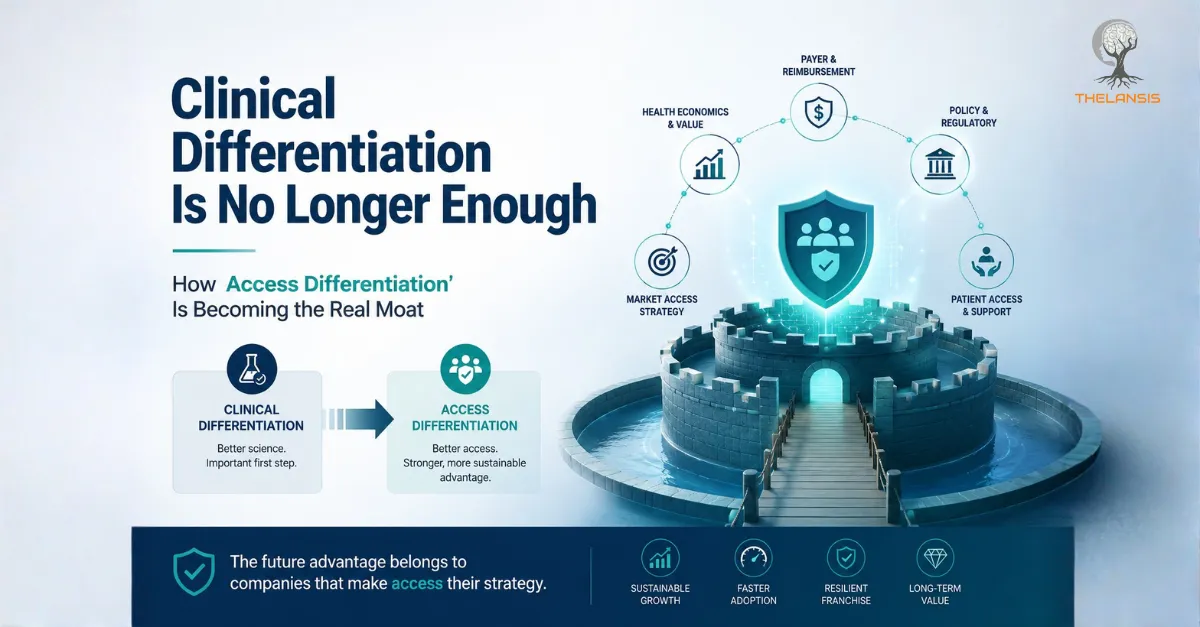
Clinical Differentiation Is No Longer Enough: How “Access Differentiation” Is Becoming the Real Moat
A therapy can post best-in-class trial data and still stall at launch. Not because the science was wrong, but because nobody could tell a payer what happens after the trial ends, when the drug meets real patients, real budgets, and real infrastructure.
That gap is where deals are won or lost today.
For years, the pharma playbook was linear: demonstrate superior outcomes, secure approval, let the market follow. Approval still opens the door. But it no longer guarantees reimbursement, formulary placement, or routine use because the definition of “value” has moved upstream, into questions that used to surface only after launch.
The shift from efficacy to adoptability
A randomized trial answers: can it work?. A payer, health system, or provider now asks a harder question: what happens when we try this with our patients, our infrastructure, our budget?
Increasingly, that means scrutiny of:
- durability of outcomes outside trial conditions
- total cost of care, not list price alone
- operational burden on providers and staff
- which patient subgroups actually benefit
- financial exposure if real-world performance varies from the trial
Vague answers to any of these translate directly into friction, such as tighter coverage criteria, step edits, slower uptake. Strong science doesn’t offset that; it just makes the stall more frustrating to watch.
What access differentiation actually means
Access differentiation is the ability to remove uncertainty for the organizations that pay for and deliver care. In practice, it shows up as five repeatable capabilities:
1. Evidence that matches payer reality
Real-world and comparative data on population performance, adherence, and downstream utilization, not just primary endpoints from the pivotal trial.
2. Economic predictability
Pricing logic and contracting structures that let payers model exposure and manage budget impact with confidence, not guesswork.
3. Operational simplicity
Clear pathways for coding, reimbursement, distribution, and patient onboarding, so adoption doesn’t require providers to build new administrative capacity.
4. Patient continuity
Support services that sustain persistence, so the outcomes shown in trials are the outcomes realized in practice.
5. Early, structured dialogue
Engaging payers and providers before launch to surface objections while there’s still time to solve them, not after they’ve hardened into coverage restrictions.
None of these five is individually new. What’s changed is that together, they now function as a system: one that’s slow and expensive for competitors to replicate, even when their molecule is comparable or better.
Why this becomes the moat
Clinical advantages compress over time: new entrants arrive, guidelines evolve, mechanisms converge, and this year’s differentiator becomes next year’s baseline.
What doesn’t compress as quickly is the infrastructure built around the product: the data flows, provider relationships, contracting muscle, and service models already embedded in payer and health-system workflows.
Once that infrastructure exists, switching costs rise for everyone downstream, even when a clinically comparable alternative shows up. The competitive advantage stops living only in the molecule. It moves into the operating model around it.
A leadership reality
Organizations that leave access strategy until late Phase III tend to negotiate from a position of weakness, building evidence packages and pricing logic reactively, against a payer landscape that’s already formed its objections. Organizations that design evidence generation, service strategy, and pricing architecture in parallel with clinical development enter launch conversations with fewer surprises and a faster runway to real-world use.
This isn’t a set of tactics to bolt on at the end. It’s a design decision made early, building adoptability into the asset alongside efficacy, not after it.
The bottom line
Strong science still earns approval. But in a budget-constrained, outcomes-scrutinized market, the therapies that scale are the ones that make the decision easy for the people paying for and delivering care. Reduce their uncertainty, and adoption follows.
That is why access differentiation, not clinical differentiation alone, is becoming the industry’s most defensible competitive advantage.