
Aug 31 2026
/
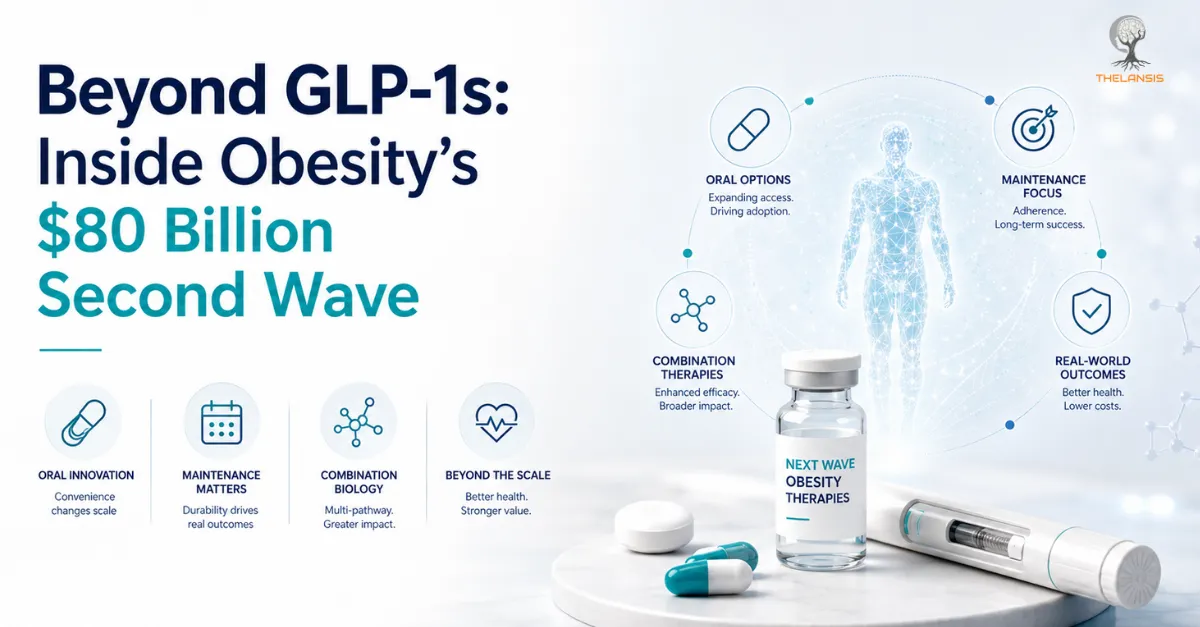
Beyond GLP-1s: Inside Obesity’s $80 Billion Second Wave
The first wave of obesity innovation proved a simple point: meaningful weight loss can be delivered at scale if patients can start therapy, stay on it, and afford it. GLP-1s turned obesity into one of the most commercially successful therapeutic categories in pharma history.
By mid-2026, the conversation is no longer about whether GLP-1s work, or even whether a second wave is coming. It’s here. The competitive fight has shifted from “Who can match the number?” to “Who can win the real-world journey?” — and the products, pricing models, and policy moves that will decide that fight are now on the table, not on the roadmap.
The Shift From “How much weight?” to “How long can you stay on it?”
In the first wave, success was defined by one number: percentage weight loss. The second wave is about holding the line, and success is now being measured by something far more difficult:
- How long do patients stay on the therapy?
- What happens when they stop?
- Can they afford it for years?
- Does it fit into everyday life?
Real-world data has already shown what physicians and payers are seeing: discontinuation rates are high, largely due to cost, side effects, and the burden of chronic injections. Weight regain after stopping therapy is common. That has created a commercial problem that’s no longer theoretical: not just losing weight, but keeping it off, and keeping patients paying and adherent for years. The next generation of products is being designed, and now launched, around maintenance, durability, and adherence.
Convenience has become a competitive weapon, and it’s already changed the market
Oral obesity drugs stopped being a talking point in the last twelve months. Novo Nordisk’s oral Wegovy pill was approved by the FDA in December 2025 and launched commercially in the US in January 2026. Eli Lilly followed with orforglipron (branded Foundayo) approved April 1, 2026 as the first small-molecule GLP-1 pill with no food or water restrictions, pushed through on the FDA’s national priority voucher pathway. Structure Therapeutics’ oral aleniglipron is positioned to be third to market, moving into Phase 3 in the second half of 2026.
These pills are doing exactly what the category expected of them: opening the door to patients unwilling to start injectables, earlier-stage obesity, self-pay and consumer-style channels, and primary care scale. Analysts now project oral options could capture around 20% of the roughly $80 billion obesity GLP-1 market by the end of the decade.
Obesity no longer looks like a specialty biologics category. It’s behaving like a chronic cardiometabolic market with high volume, retail-driven, and brand-led and the companies that cracked oral delivery with credible efficacy are the ones now positioned to reach a population injectable-only strategies never could.
Maintenance is now a live pricing and access battleground
Extended dosing intervals, better tolerability, and long-term metabolic stability aren’t just positioning goals anymore, they’re showing up in real launch strategy. Foundayo is being sold at roughly $149/month for starting doses up to around $349–399/month for higher doses, with Lilly offering coupons to bring cost-sharing for commercially insured patients down to about $25/month. CagriSema, Novo’s amylin-GLP-1 combination, was filed with the FDA in December 2025 with a decision expected around October 2026 and it’s expected to carry a premium price point north of $1,500/month, positioning it as a higher-efficacy, higher-cost alternative rather than a mass-market play.
This is where the maintenance story collides with the affordability story. About 55% of commercial employers currently cover GLP-1s for obesity, but 15% of those have already dropped coverage because the cost proved unsustainable. The proliferation of oral options and lower list prices is expected to increase pressure from employees to reinstate or expand coverage, which puts payers and employers squarely in the middle of the maintenance conversation.
In November 2025, the Trump administration struck deals with Lilly and Novo aimed at lowering GLP-1 prices, a policy lever that didn’t exist when the “maintenance labels” idea was first framed as a future trend, and one that will shape how sustainable long-term dosing actually gets priced.
In short: 2026 is the year “maintenance” stopped being a positioning concept and became a pricing tier with its own coupons, payer fights, and government intervention attached.
Combination biology is where the differentiation is actually happening now
The next competition isn’t GLP-1 versus GLP-1, it’s multi-pathway versus single-pathway, and the data is now in hand rather than pending.
GLP-1s solve appetite, but obesity is more complex than hunger alone. The second wave has leaned hard into combination biology to address satiety, energy expenditure, metabolic efficiency, lean mass preservation, and GI tolerability:
- CagriSema (Novo): semaglutide plus the amylin analog cagrilintide, filed with the FDA and showing roughly 22.7% weight loss, matching Zepbound’s efficacy through a different mechanism, with demonstrated preservation of lean body mass and bone mass.
- Retatrutide (Lilly): a triple agonist hitting GLP-1, GIP, and glucagon receptors. Phase 3 TRIUMPH data has now reported the highest weight loss ever recorded in the class: an average of 28% of body weight at the top dose, with roughly half of participants losing more than 30%. A filing is expected late 2026 or in 2027.
- Survodutide (Boehringer Ingelheim / Zealand Pharma): a GLP-1/glucagon dual agonist in Phase 3 for both obesity and liver disease.
- Amylin-only and oral amylin programs: Zealand/Roche’s petrelintide, Lilly’s eloralintide, and Structure Therapeutics’ oral small-molecule amylin candidates are all advancing, with industry-wide deal activity (Pfizer’s acquisition of Metsera, AbbVie’s $2.2 billion deal with Gubra) signaling that amylin is now treated as a durable second pillar of obesity medicine, not a side bet.
Combination regimens aren’t a 2026 prediction anymore, they’re becoming the standard path for patients who plateau, relapse, or can’t tolerate high-dose GLP-1s, with roughly 193 obesity therapies now in active development across the industry.
The real differentiation is already living beyond the headline number
As weight-loss percentages cluster near the top of the range, marketing has moved past before-and-after photos. The real story is now built around durability of response, tolerability-driven adherence, cardiometabolic risk reduction, body composition, and discontinuation outcomes, and GLP-1s themselves are being repositioned around this broader outcomes story, with active FDA review of Wegovy for heart failure with preserved ejection fraction and Ozempic for peripheral artery disease.
Payers, employers, and governments don’t just want weight loss. They want fewer diabetes diagnoses, fewer cardiac events, fewer orthopedic surgeries, and lower long-term healthcare costs. That’s where the second wave is actually being won, not in press releases, but in population-level outcomes and, increasingly, in the pricing and coverage decisions that determine who gets access at all.
The bottom line
Obesity no longer feels like a biotech miracle story. It’s a full-scale chronic disease industry, with induction drugs, maintenance drugs, oral mass-market brands, combination regimens, employer-led access models, and consumer-style distribution all live in the market simultaneously, not lined up on a roadmap.
The companies winning aren’t just the ones with the best molecule. They’re the ones managing the full journey from first prescription to year five: pricing it sustainably, getting payers to cover it, and keeping patients on it long enough for the outcomes data to show up. The GLP-1 revolution proved obesity could be treated. The second wave, now well underway, is deciding who can treat it sustainably, and who can afford to.