
Nov 10 2026
/
AI Can Summarize Research, But It Can’t Tell You What Experts Actually Think
A few years ago, a first look at a disease area meant a week of searching, reading and copying numbers into a spreadsheet, then hoping you hadn’t missed the one paper that mattered. Today you can type a question into an AI tool and get a tidy summary in under a minute. That has changed our industry. It hasn’t made research partners obsolete, but it has changed what they’re for.
What AI does well
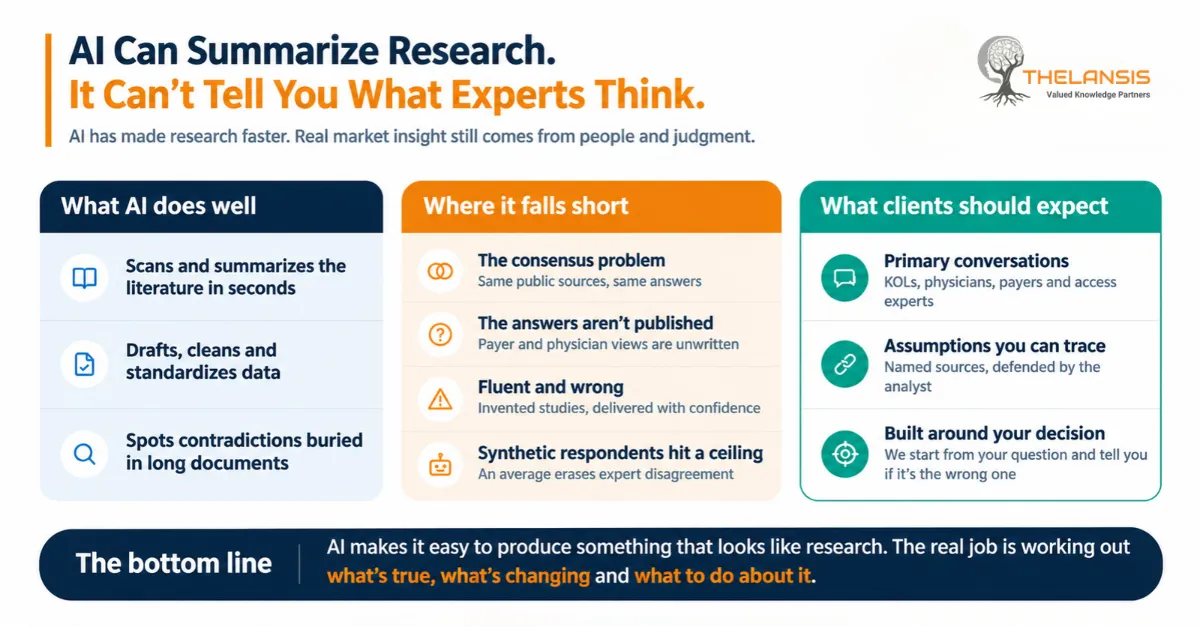
The published record is enormous. PubMed holds more than 35 million citations, and ClinicalTrials.gov lists over half a million registered studies. No team reads all of that, but AI can scan, sort and summarize it faster than any analyst. It’s also good at first drafts, cleaning messy datasets, standardizing drug names and spotting contradictions in long documents.
Clients have noticed. Basic information gathering is now expected to be quick, and a report that mostly repackages public information is getting harder to justify. That’s fair, and it frees analysts for the work that needs a person.
Where it falls short
Everyone gets a similar answer. Put the same question about the same disease to ten companies’ AI tools and you tend to get ten very similar summaries, because they all draw on the same public pool. What everyone knows is background. An edge comes from knowing something others don’t, like a payer’s real threshold or a KOL’s honest worry about a mechanism.
The best questions have no published answer. How will German payers treat a single-arm trial in this indication? What would make a neurologist move a stable patient to a new therapy? Why did a competitor’s launch stall despite a clean label? Those answers sit with physicians, payers, trialists and patient groups, and the only way to get them is to ask.
Rare disease makes the gap wider. There are an estimated 7,000 or more rare diseases, and only around 5% have an FDA-approved treatment. For many, the evidence is a handful of papers and a small trial or two. A model working from that thin record will still give you a fluent, confident answer.
It can be wrong with a straight face. Language models are known to invent studies, endpoints and patient numbers, and the problem has already reached the literature. A Columbia University team audited nearly 2.5 million open-access biomedical papers and reported the results in The Lancet in May 2026. In 2023, about one in 2,828 papers contained at least one reference to a study that doesn’t exist. By early 2026, the figure was about one in 277. The authors note that other factors, such as paper mills, can’t be ruled out, but the sharp rise began as AI writing tools spread. In pharma, one wrong prevalence figure can inflate a forecast, and a polished report is the last place anyone thinks to check the footnotes.
A note on synthetic respondents
A growing trend is using AI to simulate survey respondents or interview participants. It’s quick and cheap, and there’s no recruiting involved. For simple, broad questions, it can give a reasonable early read.
Specialist healthcare is a different matter. A simulated respondent is essentially an average of what has already been written about people like them, so it rarely surprises you. The number of real experts in a speciality is small and their views often split, and the disagreement between two KOLs is often where the useful insight is. Synthetic data can help test a questionnaire or sketch early ideas. It won’t tell you what a real clinician or payer would say.
Using AI in your own research
Two habits are worth keeping. Trace every number that matters. Treat AI output as a first pass and follow any figure back to its original source. A prevalence estimate that turns out to come from a different population or a different year is exactly the kind of error a fluent summary hides. Then ask what the tool can’t know, and be wary when every tool and every report agrees. Current payer attitudes, physician behavior and unpublished data all need a human source. And agreement often means a shared source, not a verified fact.
Where Thelansis fits
AI has made the easy parts of research cheap, so we spend our time on the parts that aren’t.
Primary research: We speak directly with KOLs, treating physicians, payers and market access experts, and also with vendors, service providers and our clients’ own teams. Their input feeds the unmet need and KOL expectation sections of our reports, our TPP insights and the uptake assumptions in our forecasts. When a physician tells us they would never switch a stable patient without a specific data point, that goes straight into the adoption curve.
Judgment you can trace: Our analysts choose the analogs, test the adoption curves and argue over assumptions until they hold. Every figure in our deliverables ties to a named source or an interview, so you can see where a number came from, challenge it, and hear the analyst who made the call defend it.
Built around your decision: We start from the question you need answered, and we’ll tell you if we think it’s the wrong one.
We use AI openly along the way, for scanning, drafting and checking. It makes us faster. It doesn’t replace the interviews, the modelling or the thinking.
The bottom line
AI has made it easy for anyone to produce something that looks like research, and easy for everyone to produce the same thing. The real job is still working out what’s true, what’s changing and what to do about it.