

Jan 15 2026
/
Japan’s Evolving HTA Landscape: What Global Launch Teams Must Know
Japan has quietly turned its HTA framework into one of the most influential, but often misunderstood, pricing systems in major markets. Since formal cost-effectiveness evaluation became part of the NHI price-setting process in 2019, the country has refined its approach almost every year. The 2024-25 policy cycle marks another step in that evolution, with changes that will matter to anyone planning global launches over the next two to three years.
For companies preparing for Japan, the question is no longer “Will HTA affect our launch?”
It’s “How early do we start shaping our value story so the HTA process doesn’t dilute our price once we’re on the market?”
What Has Actually Changed by 2025?
A few updates drive most of the practical impact:
1. Cost-effectiveness evaluation is now routine in defined situations
Japan continues to require manufacturers to submit health-economic analyses when list prices are high, premiums are involved, or comparator uncertainty is high. The National Institute of Public Health (NIPH) updated its CEA preparation guideline in 2024, tightening expectations for clinical evidence, Japanese cost data, and sensitivity analyses. This matters because the public re-analysis done independently often diverges from the manufacturer’s submission and becomes the reference point in negotiations.
2. Pricing reforms in 2024-25 reshape how value is rewarded
Two policies stand out:
Innovation-related premiums were updated, with clearer criteria for maintaining or losing these premiums during post-listing reviews. Discrepancy rate-based revisions became more prominent ahead of the 2025 NHI cycle. If actual market transaction prices fall too far below the listed price, repricing is triggered even outside the usual revision year. This creates a new pressure point for forecasting: the price you launch with may not be the price you keep, even in year one.
3. ICER expectations have become more transparent in practice
Japan still avoids a formal willingness-to-pay threshold, but analyses over the past few years consistently reference ranges around ¥5 million per QALY as a workable benchmark in
HTA-driven price adjustments. It isn’t a hard cutoff, but global teams should treat it as an anchor when building early models.
4. Post-listing evidence now has a real role
Japan’s system doesn’t use HTA to deny coverage; it uses it to adjust prices. That means RWE, especially around real-world utilization, cost offsets, and patient-reported outcomes, can help defend premiums or reduce downward pressure in subsequent reviews.
Why These Shifts Matter for Global Launch Teams?
Japan doesn’t behave like the UK or Germany, where HTA decisions can shut a product out of reimbursement. Instead, Japan reimburses broadly but uses HTA to determine how much value the system is willing to pay for.
For global launch teams, here’s the real takeaway:
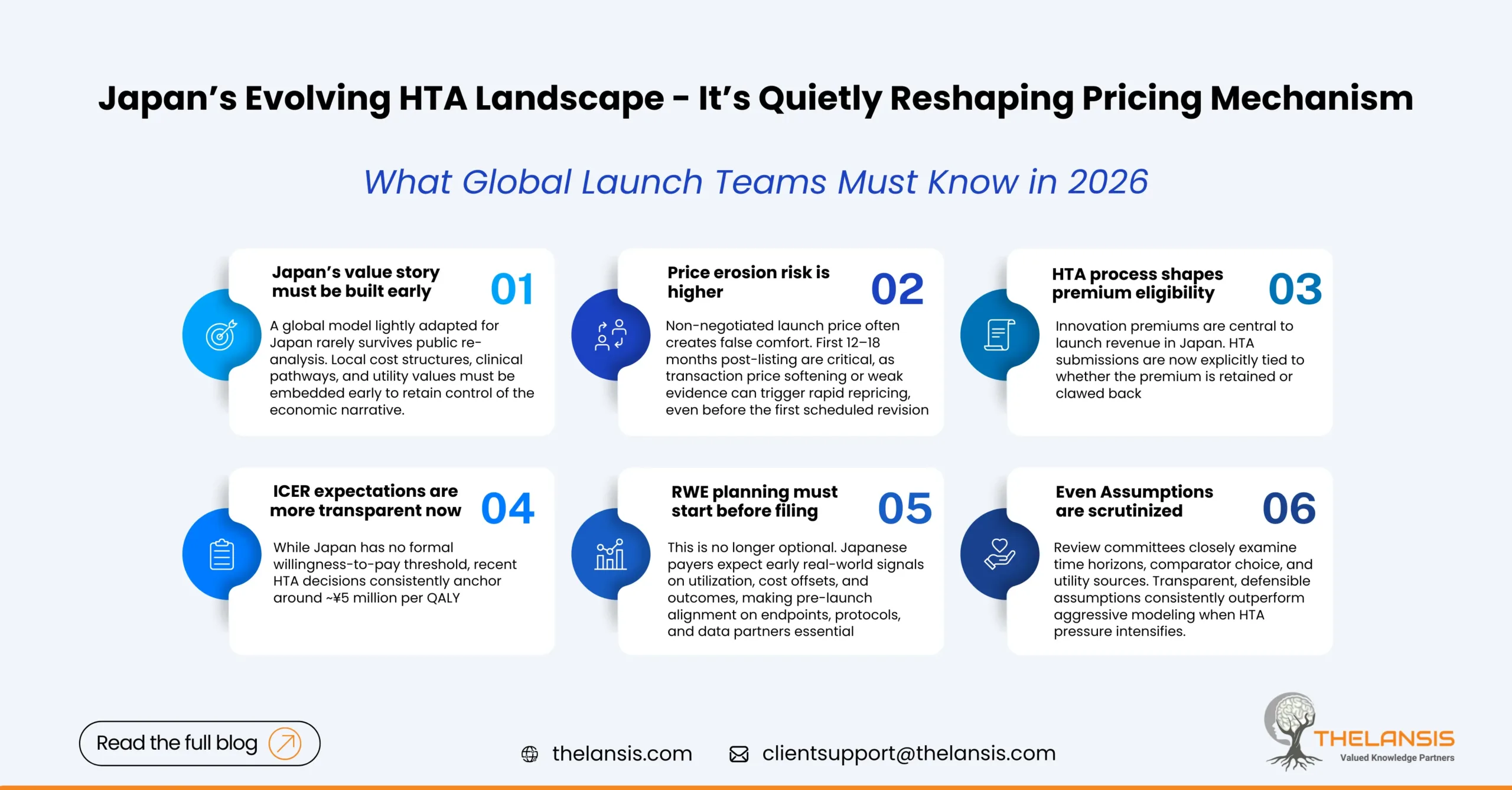
1. The economic narrative must be built early, not retrofitted before pricing negotiations
A “global model with a Japan tab added later” rarely stands up to scrutiny. Japanese cost structures, clinical practice patterns, and utility values differ meaningfully from US/EU assumptions. When these mismatches surface during public re-analysis, the manufacturer loses control of the economic story.
2. Price erosion risk is higher than many teams expect
Japan’s non-negotiated initial list price often gives teams a false sense of comfort. But the first 12-18 months after listing are critical: if observed transaction prices soften, or if evidence is deemed insufficient to justify a premium, cuts can be swift.
3. The HTA process shapes premium eligibility
Innovation premiums are central to launch revenue in Japan. HTA submissions, particularly those on clinical differentiation and burden of illness, are now explicitly tied to whether the premium is maintained.
4. RWE planning must begin before launch
If Japanese payers expect to see real-world outcomes within the first year, companies need protocols, endpoints, and data partners identified before they file.
What a Smart Japan Launch Strategy Looks Like in 2026?
Instead of treating HTA as a regulatory box-tick, launch teams should weave it into the broader market-access strategy. The most successful launches we see have a few things in common:
A Japan-specific health-economic model, not a lightly adjusted global one:
This includes local epidemiology, medical resource use, and preference weights. Teams that invest here early tend to face fewer surprises during the public re-analysis stage.
Transparent, defensible assumptions:
Japan’s review committees scrutinize assumptions heavily, particularly time horizon, utility sources, and comparator choice. A transparent model with well-explained reasoning often withstands HTA pressure better than an aggressively optimistic one.
A clear post-marketing evidence plan:
Japan rewards manufacturers who show commitment to reducing uncertainty. Claims database studies, pragmatic cohorts, and registry linkages can all help maintain premiums during the first price revision.
Tight monitoring of market transaction prices:
Because discrepancy-rate repricing can be triggered early, commercial teams must monitor discounting behavior and tender patterns closely.
A Practical Checklist for Launch Teams
- Have we built a Japan-specific CEA base case with fully local inputs?
- Do we understand which premium routes we’re targeting and the evidence thresholds tied to them?
- Is our PMDA consultation coordinated with payer/HTA messaging, or running in silos?
- Do we have a pre-launch RWE plan with endpoints linked to anticipated HTA uncertainties?
- Have we modeled downside scenarios, especially early repricing triggered by transaction data?
- Have we prepared for divergences between manufacturer and public analyses?
These questions sound simple, but the companies that can answer “yes” to all of them tend to navigate the shifting environment with far fewer pricing shocks.
The Bottom Line
Japan’s HTA environment doesn’t fundamentally change the country’s commitment to broad access. What it does change is the predictability of value capture. The companies that come prepared with localized economic evidence, transparent models, and early RWE plans are finding that Japan can still reward innovation, just not automatically.