

Nov 26 2025
/
Epilansis: A NextGen, Cloud-based Epidemiology Platform for Faster, Smarter Market Decisions
With the healthcare landscape shifting rapidly, teams across biopharma, consulting, med-tech, and healthcare strategy face a common bottleneck: turning scattered epidemiology data, literature, real world data and competitive signals into clear, actionable insights.
Epidemiology remains the backbone of clinical development, commercial planning, medical strategy, and portfolio decision-making but in most organizations, the data is still fragmented, inconsistent, or slow to update.
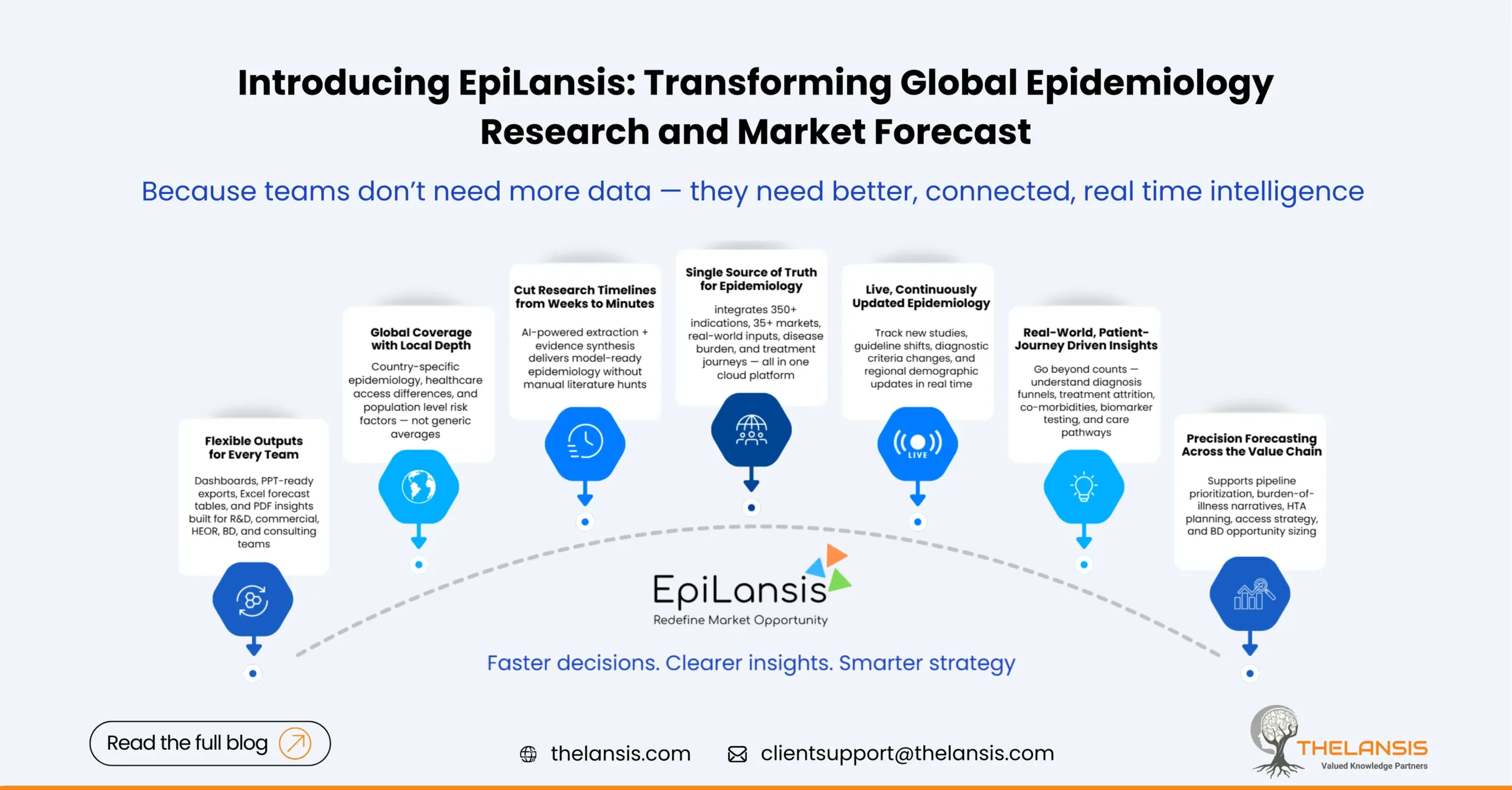
EpiLansis, an AI-powered epidemiology and forecasting platform by Thelansis, was designed to address the pain points. Built for scientific, commercial, and strategy teams, EpiLansis brings together real-time epidemiology data, global disease burden matrix, potential patient funnel, treatment landscapes, patient journey analytics, and disease burden insights— all in one cloud-based environment.
With 350+ indications, 35+ global markets, and a robust AI-driven research engine, the platform empowers teams to move faster, reduce uncertainty, and base decisions on validated, publication-ready evidence.
Why EpiLansis Matters for the Industry?
1. Reduces Research Timelines From Weeks to Minutes
Most epidemiology projects require: screening hundreds of publications, extracting indicators specific to prevalence, incidence, severity, treatment settings, mortality, and validating population splits and reconciling contradictory studies.
EpiLansis compresses this entire workflow.
Its AI engine automates literature extraction, summarizes findings, and presents evidence ranges with clear assumptions. Analysts and strategists can access trusted, model-ready data in minutes; an operational advantage when teams are working across multiple TAs or early pipeline assets.
Use case example:
An oncology strategy team exploring a rare sub-indication can quickly validate patient pool feasibility, assess unmet needs, and flag regional disparities, all before jumping into a full-fledged research.
2. Enables Patient-Centric, Real-World Driven Data generation and Decision Making
Modern drug development requires more than static epidemiology numbers. Teams need a deeper, patient-journey level understanding like:
- How are patients symptomatic?
- How early do patients receive a diagnosis?
- What is the journey between primary care, specialists, and tertiary centers?
- Where do treatment gaps widen?
- How many patients switch therapies, discontinue, or go unmanaged?
EpiLansis includes real-world epidemiology inputs, demographic granularity, and burden modeling that mirrors real patient journeys. This helps teams design more realistic forecasts, patient-centric market strategies, better inclusion/exclusion criteria and region-specific launch planning.
Example: For chronic neurodegenerative diseases, the platform highlights gender split variations, age clustering, co-morbidity status, biomarker level testing, and diagnostic funnel attrition insights that are generally missed in traditional epi insight reports.
3. Dynamic, Continuously Updated Data for Confident Forecasting
The epidemiology landscape evolves constantly. New studies, demographic changes, population updates, guideline shifts, diagnostic criteria changes, and emerging diagnostic technologies can all impact patient estimates.
EpiLansis ensures users always work with the latest intelligence by tracking: new publications, changes in disease definitions, shifts in treatment patterns, real-world data, payers data, regional population demographics etc.. This is especially critical for novel therapy areas, rare diseases and fast-moving spaces like immunology, respiratory, and oncology.
4. Powerful Use Cases Across the Biopharma Value Chain
Pipeline Prioritization & Opportunity Sizing
- Quantify patient pools across 35+ markets
- Assess feasibility for early clinical decisions
- Benchmarking multiple disease areas to support decisions
- Spot high-value niche patient segments within broader TA
Epidemiology and disease burden
- Understand the demographic distribution of patients across types, subtypes, and severity classes
- Overall, country-specific treated patient pools with respect to the SOC
- Map gaps between epidemiology and treatment adoption and compliance
Launch Strategy & Access Planning
- Identify high-burden geographies
- Define asset or indication prioritization sequences
- Support pricing & access narratives with burden of illness insights
- Strengthen HTA submissions with validated disease burden data
RWD-Backed Forecast Modeling
- Secondary data: Peer-reviewed journals, registries, claims datasets, and national health reports
- Primary validation: KOL interviews, clinical panels, practice-pattern validation
- Expert insights: Validated by subject-matter experts for medical and statistical coherence
- Real-world registries (where available): Patient-level registries, programmatic summaries, diagnostic/treatment trends
- Demographic modeling
5. True Global Coverage, Local Depth
The platform spans more than 35 markets and treats each one on its own terms. Instead of relying on broad global averages, it reflects the real epidemiology of each region.
Users can compare:
- Regional diagnostic criteria
- Incidence/prevalence/ treated variance
- Healthcare system-driven access differences
- Population-specific risk factors
Example:
For metabolic disorders, prevalence in North America may be driven by lifestyle risks, while APAC patterns may be linked to genetic predisposition and screening gaps, these are two very different narratives requiring localized planning.
6. Customizable Outputs Tailored to Every Team
Different stakeholders consume data differently. Whether a team needs a rapid snapshot or a deep-dive data pack, the platform adapts effortlessly.
- Interactive dashboards for quick visualization
- Exportable data tables for modelers
- PDF reports for medical & clinical teams
- PowerPoint outputs for strategy & leadership
- Excel-based forecast models for commercial teams
Who Benefits the Most from EpiLansis?
Bopharma R&D Teams
Assess disease burden, feasibility of clinical trials and patient recruitment, and clinical investments.
Commercial & Forecasting Teams
Build reliable market models with confidence in epidemiology inputs.
Medical Affairs & HEOR Teams
Support burden-of-illness, disease burden narratives and HTA dossiers.
Investors & BD Teams
Evaluate asset potential, licensing attractiveness, and market sizing quickly.
Consulting Firms
Accelerate delivery timelines across therapy areas with a single source of truth.
The EpiLansis Advantage: Built for the Future of Healthcare Intelligence
The industry is shifting to data-driven, patient-centered, globally aligned decision-making. EpiLansis enables this shift by offering:
- Real-time intelligence
- Transparent methodology
- AI-enhanced research
- Global therapeutic coverage
- Flexible outputs
Whether you’re exploring new indications, optimizing a launch plan, or building a long-term pipeline strategy, EpiLansis ensures you have the right data, at the right time, in the right format.
It doesn’t just streamline epidemiology, it elevates decision-making, reduces uncertainty, and brings patient realities closer to strategic planning.
EpiLansis is not just a tool. It’s a new way to understand diseases, markets, and patients—smarter, faster, and with absolute confidence.